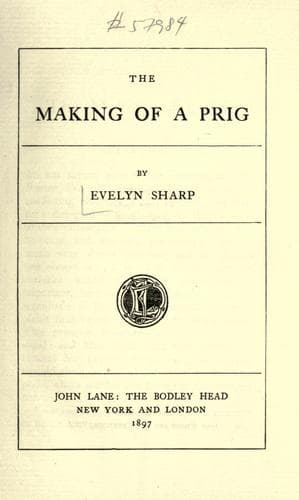
England -- Social life and customs -- 19th century -- Fiction
There was a pause, till Katharine roused herself to speak in a
lifeless kind of voice that did not seem to belong to her.
"I am sorry if it has made you unhappy," she said. Paul looked at her
critically.
"Are you sure?" he asked, smiling.
Katharine folded and unfolded her hands uneasily, and wished he would
go away and remove his disquieting presence from her life for ever.
"Oh, yes," she said. "One is always sorry when people are unhappy, of
course."
"Only that?" His voice had a touch of disappointment in it, and she
began to tremble for her composure. He got up and walked to the window
and looked across the lawn, where the wintry sun was struggling
through the bare branches of the elm trees and making faint intricate
patterns on the whitened grass below. "This is where I first met you,
three years ago," he went on as though he were talking to himself.
"You were only a child then, and you interested me. I used to wonder
what there was about you that interested me so much, a mere child like
you! You were very sweet to me in those days, Katharine."
"I--I wish you wouldn't," said Katharine. But he did not seem to hear
her.
"Most men would have behaved differently, I suppose," he went on,
still looking away from her. "It is very fatal to admit the
possibility, even to ourselves, of making a new system for an effete
civilisation like ours; and I was a fool to suppose that women could
be dealt with by any but the obvious methods. It is my own fault, of
course, that in my anxiety to keep your respect I managed to destroy
your affection."
She wanted to vindicate herself, to protest against what seemed to her
his confident self-righteousness; but the old influence was creeping
over her again, and it numbed her.
"I wish you would not say those things," she said, weakly. The
unopened letter lying on the red table-cloth seemed like a protest
against the futility of the scene that was passing, and she found
herself controlling a desire to laugh at the mockery of it all.
He turned round again with a half-suppressed sigh, and took out his
watch.
"Just twelve," he said, reflectively. "I must be off if I mean to
walk to the station. You will forgive me for having worried you with
all this? I had a sort of feeling that I should like to tell you about
it myself; our old friendship seemed to demand that little amount of
frankness, though I suppose you will think I have no right to talk
about friendship any longer. I acknowledge that I have given you every
reason to be vexed with me; if I can ever do anything to remove the
disagreeable impression from your mind, I hope you will let me know.
Good-bye."
"You--you are not going?" She had risen too, and was standing between
him and the door. She did not know why she wished to keep him, but she
knew she could not let him go.
"Unless you can show me a satisfactory reason for remaining," was his
reply. She was trembling violently from head to foot.
Public-domain text, read in full here on John Shaqi.
Reviews
Reviews
No reviews yet
Be the first to share your thoughts on this work.
Elsewhere in the archive
Join the Discussion
Join the discussion
Sign in to leave a comment or review.
Sign InorCreate an account