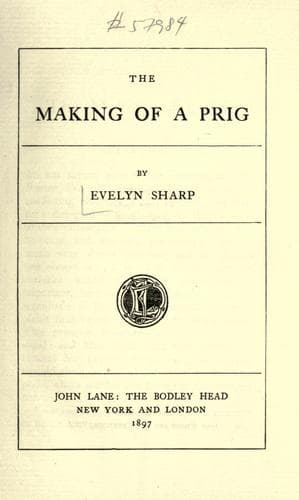
England -- Social life and customs -- 19th century -- Fiction
"It is impossible," he said. "I decline to believe what you say now,
after what you said to me on Monday afternoon."
"Ah," she cried, "I was mad then. You always make me mad when I am
with you. You must not talk any more of Monday afternoon; you must
forget what I said to you then, and what I have said to you to-day;
you must forget that I have allowed you to kiss me--"
"Forget?" interrupted Paul. "Are _you_ going to forget all this?"
She turned away with a little cry.
"You make it so hard for me, Paul; and it seemed so easy before you
came!"
"Then it doesn't seem so easy now?"
She evaded his question. "I know I am right, because I thought it all
out when you were not here," she went on piteously. "I cannot trust
myself even to think properly when you are there; you make me quite
unlike myself. That is why I am going to marry Ted. Ted is the sanest
person I know; he leaves me my individuality; he doesn't paralyse me
as you do; and I am simply myself when I am with him."
"Simply yourself!" echoed Paul. "My dear little girl, whatever in
heaven or earth has allowed such a misapprehension to creep into your
head?"
"I know what you mean," she said. "I have thought that out, too. You
know more about me than anybody in the whole world; Ted will never
know as much as you know, although I am going to be his wife. You are
the only person I could ever talk to about myself; you are the only
person who understands. I know all that. But one does not want that in
a husband; one wants some one who will be content with half of one's
self, and allow the other half to develop as it pleases. You would
never be content with less than the whole, would you, Paul? Ah, that
is why I loved you so madly! It is so queer, isn't it, that the very
things that make us fall in love are the very things that make
marriage impossible?"
He did not speak, and she put her arms round his neck impulsively and
drew his head down to hers.
"Don't you understand, dear?" she said. "It is impossible to find
everything we want in one person, so we have to be content with
satisfying one side of ourselves, or accept the alternative and not
marry at all. Ted wants me badly, or I would rather choose not to
marry at all. But he must have some one to look after him,--he can't
live alone like some men; and I have always looked after him all my
life. He has come in my way again now, so I am going to look after him
to the end. I am very fond of Ted, and we have learnt to be chums, so
I don't think it will be a failure. Oh, do say you understand, Paul?"
"Do you love him?" asked Paul.
"Yes," she replied.
"As you loved me?"
"No," said Katharine, simply. "I could never love any one again like
that. I wore myself out, I think, in my love for you. Oh, I know I am
spoiled; I know I have only the second best of myself to give to Ted;
but if he is content with that, ought I not to be glad to give it?"
Public-domain text, read in full here on John Shaqi.
Reviews
Reviews
No reviews yet
Be the first to share your thoughts on this work.
Elsewhere in the archive
Join the Discussion
Join the discussion
Sign in to leave a comment or review.
Sign InorCreate an account