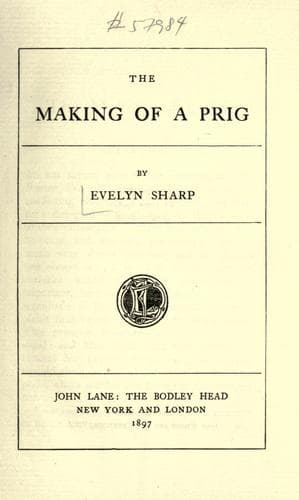
England -- Social life and customs -- 19th century -- Fiction
It was more than a year since she had accepted Mrs. Downing's offer
and settled here in Paris; more than a year since Ted had gone abroad
and Paul Wilton had bidden her farewell. But she never looked back on
those days now, though not so much from design as from lack of
incentive; for her life had strayed into another channel, and her days
were full of the kind of occupation that leaves no room for the luxury
of reminiscence. It never even occurred to her to wonder whether she
was happy or not; she seemed to have completely lost her old trick of
wanting a reason for everything she thought or felt, and for the time
being she had become eminently practical. Even now, in spite of the
enervating effect of the first spring weather, her thoughts returned
to the business of the moment, and she wondered why the father of her
newest pupil, who had made an appointment with her for eleven o'clock,
was so late in coming. A ring at the electric bell seemed to answer
her thought, and the maid came in almost immediately with a
gentleman's card on a tray.
"British caution," was Katharine's criticism, as Julie explained that
the English monsieur had not attempted to teach her his name. By the
merest chance she glanced at the card before her visitor came in, and
was spared the annoyance of betraying the surprise she must otherwise
have felt. As it was, she had time to recover from her astonishment,
even to remark how different the familiar name and address seemed to
her when, for the first time as now, she saw them transcribed on a
visiting card,--"Mr. Paul Wilton, Essex Court, Temple."
"I am so glad to see you," she exclaimed, with a look that did not
contradict the welcome in her voice. And Julie, who had never seen
her mistress look so joyous before, went back to Marie in the kitchen
with a highly coloured account of the meeting she had just witnessed,
which explained to that frivolous but astute little person how it was
that Madame always looked so leniently on her flirtations with the
_charcutier_ round the corner.
"I have never caught you idling before," said Paul, referring to the
attitude in which he had seen her through the open door before she had
turned round with that glad look in her eyes.
"I don't suppose you have," she said. "It isn't so very long since I
learnt how to idle. Do you remember how bitterly you used to complain
because I never wanted to lounge? I often lounge now; and my greatest
joy is to think about nothing at all. Don't you know how restful it is
to think about nothing at all?"
"You must have altered a good deal," he observed.
"Do you think I have, then?"
"Ask me that presently," he replied, with an answering smile. "I have
got to hear all the news first,--how keeping school agrees with you,
and everything there is to tell about yourself. So make haste and
begin, please."
Public-domain text, read in full here on John Shaqi.
Reviews
Reviews
No reviews yet
Be the first to share your thoughts on this work.
Elsewhere in the archive
Join the Discussion
Join the discussion
Sign in to leave a comment or review.
Sign InorCreate an account