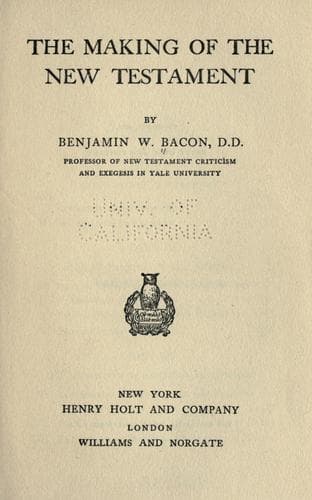
The Making of the New TestamentBacon, Benjamin Wisner
Religion
The Making of the New Testament
Bacon, Benjamin Wisner
Bible. New Testament -- Introductions
(2) In the effort for apostolic authority the writings which came
ultimately to represent Asian orthodoxy have all been brought under the
name and authority of the Apostle John, although for many decades after
the appearance of Revelation, Paul, and not John, remains the apostolic
authority to which appeal is made, and although the writings themselves
were originally anonymous. There was, indeed, a contributory cause for
the growth of this tradition in the accidental circumstance that a
Palestinian Elder from whom Papias derived indirect, and Polycarp in all
probability direct, traditions, bore also the name of John, and survived
until A.D. 117. Still, the main reason why this particular apostolic
name was ultimately placed over the Gospel and Epistles of Ephesian
Christendom, can only have been its previous adoption to cover the
compilation of Palestinian 'prophecies' of A.D. 95.
PART IV
THE LITERATURE OF THE THEOLOGIAN
CHAPTER IX
THE SPIRITUAL GOSPEL AND EPISTLES
Asia, as we have come to know it through a succession of writings dating
from Colossians-Ephesians (_c._ 62) down to Papias (145), had come to be
the chief scene of mutual reaction between 'apostolic' and Pauline
Christianity at the close of the first century. Here at Ephesus had been
the great headquarters of Paul's missionary activity. Here he had
reasoned daily in the school of one Tyrannus, a philosopher, and had
found "many adversaries." Here he had encountered the "strolling Jews,
exorcists," and had secured the destruction of an immense mass of books
of magic. Here, according to Acts, he predicted the inroads of heresy
after his "departure," and here the succeeding literature abundantly
witnesses the fulfilment of the prediction. Ephesians and Colossians
begin the series, the Pastoral Epistles (_c._ 90) continue it. Then
follow the 'letters to the churches' of Revelation (95) and the
Ignatian Epistles (110-117), not to mention those whose origin is
uncertain, such as Jude and 2nd Peter.
Public-domain text, read in full here on John Shaqi.
Reviews
Reviews
No reviews yet
Be the first to share your thoughts on this work.
Elsewhere in the archive
Join the Discussion
Join the discussion
Sign in to leave a comment or review.
Sign InorCreate an account