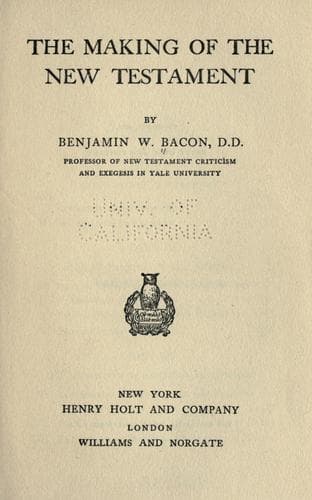
The Making of the New TestamentBacon, Benjamin Wisner
Religion
The Making of the New Testament
Bacon, Benjamin Wisner
Bible. New Testament -- Introductions
It is when we approach the Fourth Gospel by way of its own author's
adaptation of his message to the conditions around him that we begin to
appreciate it historically, and in its true worth. The spirit of polemic
is still prominent in 1st John, but the Gospel shows the effect of
opposition only in the more careful statement of the evangelist's exact
meaning. It is a theological treatise, an interpretation of the doctrine
of the person of Christ, written that the readers "may believe that
Jesus is the Christ, the Son of God, and that believing they may have
life in his name" (xx. 31). In an age so eagerly bent on ascertaining
the historic facts regarding Jesus' life, and the true sequence of
events (Luke i. 1-4), it is insupposable that an author so strenuous to
uphold the concrete reality of the church's historic tradition should
not give real history so far as he was able. He could not afford to
depreciate it in the face of Doketic myth and fancy and contempt for a
"Christ in the flesh." The idea that such a writer could deliberately
prefer fiction to fact is most improbable; ten times more so if he was
the only surviving representative of the twelve, a Galilean disciple
even more intimate than Peter with Jesus from the outset. But real
history was no longer attainable. The author of the Fourth Gospel
reports no event which he does not take in good faith to be fact. Yet it
must be apparent from his own statement of his purpose as well as from
the very structure of the book that he does not aim to be a historian,
but an interpreter of doctrine. He aims to give not _fact_ but _truth_.
And his handling of (supposed) fact has the freedom we should expect in
a church teacher of that age, and of the school of Paul the mystic. The
seven progressive "signs" that he narrates, culminating in the raising
of Lazarus, are avowedly (xx. 31) illustrative selections from a
multitude of current tales of miracle, aiming to produce that faith in
Jesus as the Son of God which will result in "life," _i. e._ the eternal
life which consists in his indwelling (1st John v. 20). They are not
described as acts of pity, drawn from one with whom the power of God was
found present to heal. Jesus does not yield as in the Synoptics when
compassion for trusting need overcomes reluctance to increase the
importunity that interfered with his higher mission. Their prime purpose
is to "manifest the glory" of the incarnate Logos, and Jesus performs
them only when, and as, he chooses. Pity and natural affection are
almost trampled upon that this "manifestation of his glory" may be made
more effective (ii. 4; iv. 48; ix. 3; xi. 4-6, 15). As in Paul, there is
no exorcism. This most typical and characteristic miracle of Petrine
story (Mark iii. 15; Acts x. 88) has disappeared. Or rather (as in Paul)
the casting out of Satan from his dominion over the entire world has
transcended and superseded it (John xii. 31-33; _cf._ Col. ii. 15). In
Public-domain text, read in full here on John Shaqi.
Reviews
Reviews
No reviews yet
Be the first to share your thoughts on this work.
Elsewhere in the archive
Join the Discussion
Join the discussion
Sign in to leave a comment or review.
Sign InorCreate an account