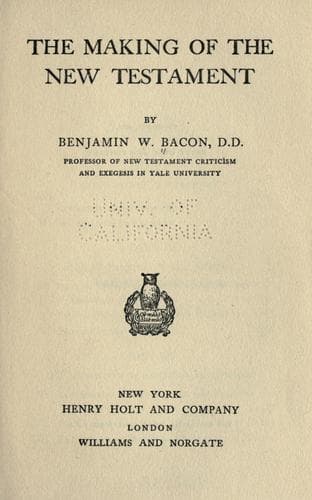
The Making of the New TestamentBacon, Benjamin Wisner
Religion
The Making of the New Testament
Bacon, Benjamin Wisner
Bible. New Testament -- Introductions
Few of the great writings cherished and transmitted by the early church
have escaped the natural tendency to attachments at beginning and end.
In the later period such attachments took the form of prefixed
_argumenta_, _i. e._ prefatory descriptions of author and contents, and
affixed _subscriptions_, devoted to a similar purpose. These, like the
titles, were clearly distinguished from the text itself, and in modern
editions are usually not printed, though examples of 'subscriptions' may
be seen in the King James version after the Pauline Epistles. Before the
time when canonization had made such a process seem sacrilege they were
attached to the text itself, with greater or less attempt to weld the
parts together. We need not add to what has been already said as to
certain superscriptions of the later epistolary literature, such as
James and Jude, where the relation to the text impresses us as closer
than is sometimes admitted; nor need we delay with the preamble to
Revelation (Rev. i. 1-3). That which has been added at the close, in
cases where real evidence exists of such later supplementation, is of
special significance to our study, inasmuch as it tends to throw light
where light is most required. For that is an obscure period, early in
the second century, when not only the churches themselves were drawing
together toward catholic unity under the double pressure of inward and
outward peril, but were bringing with them their treasured writings,
sometimes a collection of Epistles, sometimes a Gospel, or a book of
Prophecy, sometimes, as in the groups of writings attributed to John and
Peter, a full canon of Gospel, Epistles and Apocalypse, followed but
little later by 'Acts' as well.
The most ancient list of books authorized to be publicly read that we
possess is that of the church of Rome _c._ 185, called after its
discoverer the Canon of Muratori. From this fragment, mutilated at
beginning and end, we learn that Paul's letters to the churches were
arranged in a group of seven[31] of which Romans stood last. It is
probably due to its position at the end that Romans has been
supplemented by the addition of Pauline fragments, which did not appear
in some early editions of the text. The letter proper ends with ch. xv.
though xvi. 21-23 probably followed, perhaps concluding with ver. 24,
which some texts insert after ver. 19. Ver. 25-27 is another fragment
omitted in some texts.
Footnote 31: The personal letters formed a separate group. Two
letters to the same church (1st Cor., 2nd Cor.) were counted as one.
Marcion (140) counted ten in all, and had a different order.
Public-domain text, read in full here on John Shaqi.
Reviews
Reviews
No reviews yet
Be the first to share your thoughts on this work.
Elsewhere in the archive
Join the Discussion
Join the discussion
Sign in to leave a comment or review.
Sign InorCreate an account