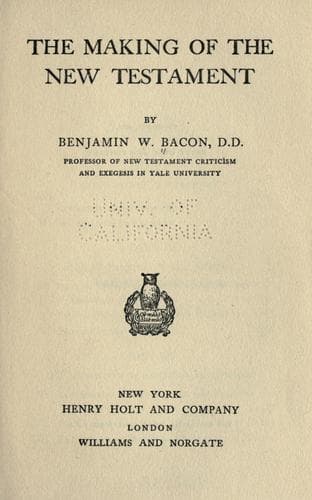
The Making of the New TestamentBacon, Benjamin Wisner
Religion
The Making of the New Testament
Bacon, Benjamin Wisner
Bible. New Testament -- Introductions
The literature of the New Testament must be understood historically if
understood at all. It must be understood as the product, we might almost
say the precipitate, of the greatest period in the history of religion.
It represents the meeting and mutual adjustment of two fundamental and
complementary conceptions of religion. The antithesis is not merely that
between the particularism of the Jew and the universalism of the
Gentile. It is an antithesis of the social ideal of Law and Prophets
against the individual ideal of personal redemption through union with
the divine Spirit, which lay at the heart of all vital Hellenistic
religious thought in this period of the Empire. Christianity as we know
it, the religion of humanity as it has come to be, the ultimate
world-religion as we believe it destined to become, is a resultant of
these two factors, Semitic and Aryan, the social and the individual
ideal. Its canonized literature represents the combination. On the one
side the social ideal is predominant. It perpetuates the gospel _of_
Jesus in the form of Matthæan and Petrine tradition, supplemented by
apocalypse, which tradition attaches conjecturally to the name of John.
The goal it seeks is the Kingdom of God, righteousness and peace on
earth as in heaven. On the other side the individual ideal predominates.
It perpetuates the gospel _about_ Jesus in the form of the Pauline and
Johannine doctrine of his person, regarded as the norm and type of
spiritual life. The goal it seeks is personal immortality by moral
fellowship with God. Its faith is Son ship, by participation in the
divine nature, without limitation in time, without loss of individual
identity. Both types of gospel are justified in claiming to emanate from
Jesus of Nazareth; but neither without the other can claim to fully
represent the significance of his spirit and life.
The unity of the New Testament is a unity in diversity. Just because it
presents so widely divergent conceptions of what the gospel is, it gives
promise of perennial fecundity. Studied not after the manner of the
scribes, who think that in their book of precept and prophecy they have
a passport to rewards in a magical world to come, but studied as a
"manifestation of the life, even the eternal life" of the Spirit of God
in man, it will continue to reproduce the spirit and mind of Christ.
Studied as a reflection at various times and in divers manners of that
redemptive Wisdom of God, which "in every generation entering into holy
souls makes men to be prophets and friends of God" (Sap. vii. 27), and
which the Greeks, considering it, unfortunately, in its intellectual
rather than its moral aspect, call the Logos of God, it will prove, as
in so many generations past it has proved, an "incorruptible seed," a
"word of good tidings preached unto" the world, a "word of the Lord that
abideth for ever."
BIBLIOGRAPHY
1. General Introductions to N.T. Literature.
Public-domain text, read in full here on John Shaqi.
Reviews
Reviews
No reviews yet
Be the first to share your thoughts on this work.
Elsewhere in the archive
Join the Discussion
Join the discussion
Sign in to leave a comment or review.
Sign InorCreate an account