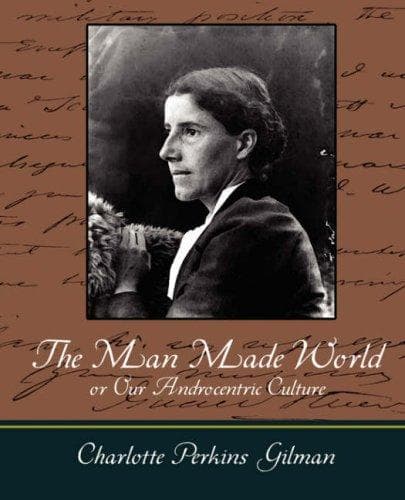
The Man-Made World; Or, Our Androcentric CultureGilman, Charlotte Perkins
General
The Man-Made World; Or, Our Androcentric Culture
Gilman, Charlotte Perkins
Women -- Social and moral questions; Women -- Social conditions
Democratic government is no longer an exercise of arbitrary authority
from one above, but is an organization for public service of the people
themselves--or will be when it is really attained.
In this change government ceases to be compulsion, and becomes
agreement; law ceases to be authority and becomes co-ordination. When we
learn the rules of whist or chess we do not obey them because we fear to
be punished if we don't, but because we want to play the game. The rules
of human conduct are for our own happiness and service--any child can
see that. Every child will see it when laws are simplified, based on
sociology, and taught in schools. A child of ten should be considered
grossly uneducated who could not rewrite the main features of the laws
of his country, state, and city; and those laws should be so simple in
their principles that a child of ten could understand them.
Teacher: "What is a tax?"
Child: "A tax is the money we agree to pay to keep up our common
advantages."
Teacher: "Why do we all pay taxes?"
Child: "Because the country belongs to all of us, and we must all pay
our share to keep it up."
Teacher: "In what proportion do we pay taxes?"
Child: "In proportion to how much money we have." (_Sotto voce_: "Of
course!")
Teacher: "What is it to evade taxes?"
Child: "It is treason." (_Sotto voce_: "And a dirty mean trick.")
In masculine administration of the laws we may follow the instinctive
love of battle down through the custom of "trial by combat"--only
recently outgrown, to our present method, where each contending party
hires a champion to represent him, and these fight it out in a wordy
war, with tricks and devices of complex ingenuity, enjoying this kind of
struggle as they enjoy all other kinds.
It is the old masculine spirit of government as authority which is so
slow in adapting itself to the democratic idea of government as
service. That it should be a representative government they grasp, but
representative of what? of the common will, they say; the will of
the majority;--never thinking that it is the common good, the common
welfare, that government should represent.
It is the inextricable masculinity in our idea of government which so
revolts at the idea of women as voters. "To govern:" that means to boss,
to control, to have authority; and that only, to most minds. They
cannot bear to think of the woman as having control over even their own
affairs; to control is masculine, they assume. Seeing only self-interest
as a natural impulse, and the ruling powers of the state as a sort of
umpire, an authority to preserve the rules of the game while men fight
it out forever; they see in a democracy merely a wider range of self
interest, and a wider, freer field to fight in.
Public-domain text, read in full here on John Shaqi.
Reviews
Reviews
No reviews yet
Be the first to share your thoughts on this work.
Elsewhere in the archive
Join the Discussion
Join the discussion
Sign in to leave a comment or review.
Sign InorCreate an account