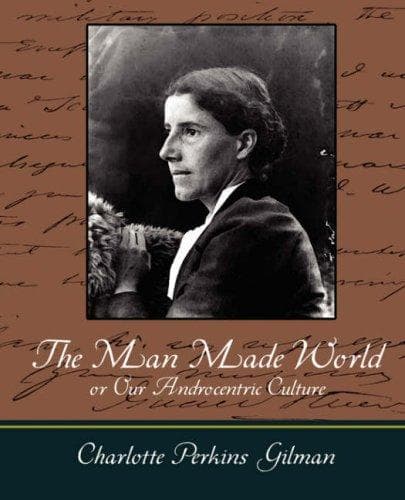
The Man-Made World; Or, Our Androcentric CultureGilman, Charlotte Perkins
General
The Man-Made World; Or, Our Androcentric Culture
Gilman, Charlotte Perkins
Women -- Social and moral questions; Women -- Social conditions
Social, or, as they are used to call it, Political Economics, covers
a larger, but not essentially different field. A family consists of
people, and the Mother is their natural manager. Society consists of
people--_the same people_--only more of them. All the people, who are
members of Society, are also members of families--except some incubated
orphans maybe. Social Economics covers the whole care and management of
the people, the maintenance of peace and health and order and morality;
the care of children, as far as done out of the home; as well as the
spending and saving of the public money--all these are included in it.
This great business of Social Economics is at present little understood
and most poorly managed, for this reason; we approach it from an
individual point of view; seeking not so much to do our share in the
common service, as to get our personal profit from the common wealth.
Where the whole family labors together to harvest fruit and store it for
the winter, we have legitimate Domestic Economics: but where one member
takes and hides a lot for himself, to the exclusion of the others, we
have no Domestic Economics at all--merely individual selfishness.
In Social Economics we have a large, but simple problem. Here is the
earth, our farm. Here are the people, who own the earth. How can the
most advantage to the most people be obtained from the earth with the
least labor? That is the problem of Social Economics.
Looking at the world as if you held it in your hands to study and
discuss, what do we find at present?
We find people living too thickly for health and comfort in some places,
and too thinly for others; we find most people working too hard and too
long at honest labor; some people working with damaging intensity at
dishonest labor; and a few wretched paupers among the rich and poor,
degenerate idlers who do not work at all, the scum and the dregs of
Society.
All this is bad economics. We do not get the comfort out of life we
easily could; and work far too hard for what we do get. Moreover, there
is no peace, no settled security. No man is sure of his living, no
matter how hard he works, a thousand things may occur to deprive him of
his job, or his income. In our time there is great excitement along this
line of study; and more than one proposition is advanced whereby we
may improve, most notably instanced in the world-covering advance of
Socialism.
In our present study the principal fact to be exhibited is the influence
of a male culture upon Social Economics and Industry.
Industry, as a department of Social Economics, is little understood.
Heretofore we have viewed this field from several wholly erroneous
positions. From the Hebrew (and wholly androcentric) religious teaching,
we have regarded labor as a curse.
Nothing could be more absurdly false. Labor is not merely a means of
supporting human life--it _is_ human life. Imagine a race of beings
living without labor! They must be the rudest savages.
Public-domain text, read in full here on John Shaqi.
Reviews
Reviews
No reviews yet
Be the first to share your thoughts on this work.
Elsewhere in the archive
Join the Discussion
Join the discussion
Sign in to leave a comment or review.
Sign InorCreate an account