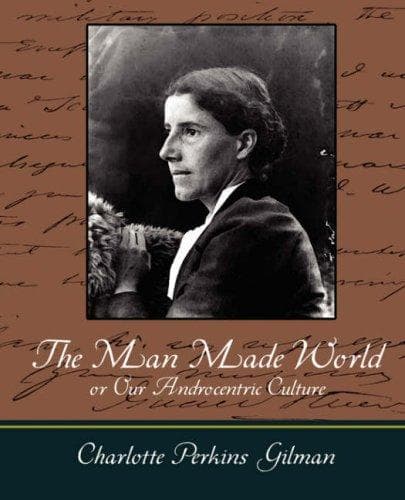
The Man-Made World; Or, Our Androcentric CultureGilman, Charlotte Perkins
General
The Man-Made World; Or, Our Androcentric Culture
Gilman, Charlotte Perkins
Women -- Social and moral questions; Women -- Social conditions
That it would be possible to develop industry to far greater heights,
and to find in social economics a simple and beneficial process for the
promotion of human life and prosperity, under any other impulse than
these two, Desire and Combat, is hard indeed to recognize--for the "male
mind."
So absolutely interwoven are our existing concepts of maleness and
humanness, so sure are we that men are people and women only females,
that the claim of equal weight and dignity in human affairs of the
feminine instincts and methods is scouted as absurd. We find existing
industry almost wholly in male hands; find it done as men do it; assume
that that is the way it must be done.
When women suggest that it could be done differently, their proposal is
waved aside--they are "only women"--their ideas are "womanish."
Agreed. So are men "only men," their ideas are "mannish"; and of the two
the women are more vitally human than the men.
The female is the race-type--the man the variant.
The female, as a race-type, having the female processes besides;
best performs the race processes. The male, however, has with great
difficulty developed them, always heavily handicapped by his maleness;
being in origin essentially a creature of sex, and so dominated almost
exclusively by sex impulses.
The human instinct of mutual service is checked by the masculine
instinct of combat; the human tendency to specialize in labor, to
rejoicingly pour force in lines of specialized expression, is checked
by the predacious instinct, which will exert itself for reward; and
disfigured by the masculine instinct of self-expression, which is an
entirely different thing from the great human outpouring of world force.
Great men, the world's teachers and leaders, are great in humanness;
mere maleness does not make for greatness unless it be in warfare--a
disadvantageous glory! Great women also must be great in humanness; but
their female instincts are not so subversive of human progress as are
the instincts of the male. To be a teacher and leader, to love and
serve, to guard and guide and help, are well in line with motherhood.
"Are they not also in line with fatherhood?" will be asked; and, "Are
not the father's paternal instincts masculine?"
No, they are not; they differ in no way from the maternal, in so far as
they are beneficial. Parental functions of the higher sort, of the human
sort, are identical. The father can give his children many advantages
which the mother can not; but that is due to his superiority as a human
being. He possesses far more knowledge and power in the world, the human
world; he himself is more developed in human powers and processes; and
is therefore able to do much for his children which the mother can not;
but this is in no way due to his masculinity. It is in this development
of human powers in man, through fatherhood, that we may read the
explanation of our short period of androcentric culture.
Public-domain text, read in full here on John Shaqi.
Reviews
Reviews
No reviews yet
Be the first to share your thoughts on this work.
Elsewhere in the archive
Join the Discussion
Join the discussion
Sign in to leave a comment or review.
Sign InorCreate an account