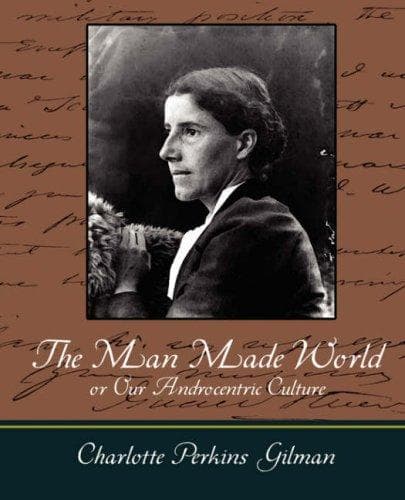
The Man-Made World; Or, Our Androcentric CultureGilman, Charlotte Perkins
General
The Man-Made World; Or, Our Androcentric Culture
Gilman, Charlotte Perkins
Women -- Social and moral questions; Women -- Social conditions
Under this more normal influence our present perversities of functions
will, of course, tend to disappear. The directly serviceable tendency
of women, as shown in every step of their public work, will have small
patience with hoary traditions of absurdity. We need but look at long
recorded facts to see what women do--or try to do, when they have
opportunity. Even in their crippled, smothered past, they have made
valiant efforts--not always wise--in charity and philanthropy.
In our own time this is shown through all the length and breadth of our
country, by the Woman's Clubs. Little groups of women, drawing together
in human relation, at first, perhaps, with no better purpose than to
"improve their minds," have grown and spread; combined and federated;
and in their great reports, representing hundreds of thousands of
women--we find a splendid record of human work. They strive always to
improve something, to take care of something, to help and serve and
benefit. In "village improvement," in traveling libraries, in lecture
courses and exhibitions, in promoting good legislation; in many a line
of noble effort our Women's Clubs show what women want to do.
Men do not have to do these things through their clubs, which are mainly
for pleasure; they can accomplish what they wish to through regular
channels. But the character and direction of the influence of women in
human affairs is conclusively established by the things they already do
and try to do. In those countries, and in our own states, where they are
already full citizens, the legislation introduced and promoted by
them is of the same beneficent character. The normal woman is a strong
creature, loving and serviceable. The kind of woman men are afraid to
entrust with political power, selfish, idle, over-sexed, or ignorant and
narrow-minded, is not normal, but is the creature of conditions men
have made. We need have no fear of her, for she will disappear with the
conditions which created her.
In older days, without knowledge of the natural sciences, we accepted
life as static. If, being born in China, we grew up with foot-bound
women, we assumed that women were such, and must so remain. Born in
India, we accepted the child-wife, the pitiful child-widow, the ecstatic
_suttee_, as natural expressions of womanhood. In each age, each
country, we have assumed life to be necessarily what it was--a moveless
fact.
All this is giving way fast in our new knowledge of the laws of life.
We find that Growth is the eternal law, and that even rocks are slowly
changing. Human life is seen to be as dynamic as any other form; and the
most certain thing about it is that it will change. In the light of this
knowledge we need no longer accept the load of what we call "sin;"
the grouped misery of poverty, disease and crime; the cumbrous,
inefficacious, wasteful processes of life today, as needful or
permanent.
Public-domain text, read in full here on John Shaqi.
Reviews
Reviews
No reviews yet
Be the first to share your thoughts on this work.
Elsewhere in the archive
Join the Discussion
Join the discussion
Sign in to leave a comment or review.
Sign InorCreate an account