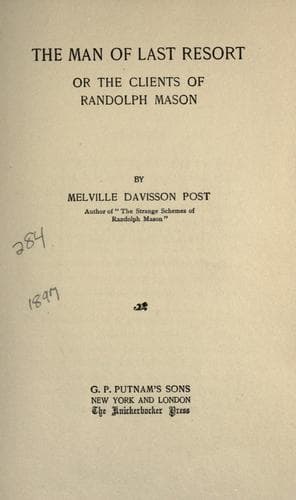
The Man of Last Resort; Or, The Clients of Randolph MasonPost, Melville Davisson
General
The Man of Last Resort; Or, The Clients of Randolph Mason
Post, Melville Davisson
American fiction -- 19th century; Detective and mystery stories, American; Legal stories, American
Carper got up from his chair, took the picture from the mantel, broke
it across the face and dropped the pieces into the fire. It was not
necessary for the marshal's deputy to speculate about this picture.
Then he went over to the cabinet and took out a pack of letters, old,
yellow, tied with a faded ribbon, and, selecting one at random, sat down
in his chair to read it through. “Dear Heart,” it ran at the beginning,
and at the end “I am unutterably lonely, and I love you.” Yes, he
recalled the circumstances of its writing well. Then he replaced it
with the others and laid them all gently on the fire. They should not be
pleasant reading for the marshal.
He had come down into the world, with his heart shredded and every shred
aching like a nerve, and from that day he had flown the black flag of
piracy. Among all the buccaneers of the street, the hand of none had
been heavier, and the brain of none had been keener than his own. From
that day every man who had passed up a prisoner on to the deck of his
galleon, had walked the plank. The muscles of his face grew tense with
the thought.
Somewhere in the house a clock struck ten. Carper arose and walked
backward and forward across the room. The spirit of fierce resistance
was beginning to awaken. He would not be stripped like a weakling. He
would fight, fight--but how? It was hopeless to dream of raising the
money. That plan had been discarded long ago. Vain vaporing! There was
no way remaining but Brutus's way--the road out into the vastness of
eternity was open! The exit was easy. Why should he lag back? Surely he
must go later on. For years the world had been a good place to get out
of--for seven years.
The man opened a drawer at the bottom of the book-case and took out a
weapon--an ancient duelling pistol of his grandfather. He carried the
weapon to the table, wiped it carefully, and began to load it. When he
had finished, he went over to close the door. On the threshold lay one
of the evening papers of the city. Carper picked it up and brought it
with him to the light. The headlines caught his attention. It was the
story of a great bank defaulter who had gone free by reason of some
defect in the law shrewdly pointed out by a lawyer, Randolph Mason.
He remembered the man as a remarkable legal misanthrope. He had heard of
him in the Federal courts. Somewhere he had this man's address, jotted
down one morning when the administrator of an estate walked out of the
Federal court a confessed gigantic thief, but, by this man's counsel,
beyond the reach of the law.
Carper looked through one of the files on his table--yes, here was
the residence number. The man leaned over and rested his arm on the
mantel-shelf. One might not do ill to go; there was time ample. One
could come back to the thing of steel later on.
Public-domain text, read in full here on John Shaqi.
Reviews
Reviews
No reviews yet
Be the first to share your thoughts on this work.
Elsewhere in the archive
Join the Discussion
Join the discussion
Sign in to leave a comment or review.
Sign InorCreate an account