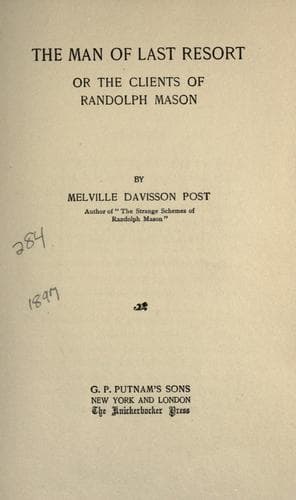
The Man of Last Resort; Or, The Clients of Randolph MasonPost, Melville Davisson
General
The Man of Last Resort; Or, The Clients of Randolph Mason
Post, Melville Davisson
American fiction -- 19th century; Detective and mystery stories, American; Legal stories, American
The little county seat on Tug River slept in a pocket. Behind it and
on every side except the river were great mountains, half-hidden by a
gigantic cloak of fog. On the opposite side, from the great coal plants
of the Norfolk and Western Railroad a counter-canopy of smoke arose,
dense and voluminous, and stretched itself like a black hand out over
the town and across to the fog of the mountain. Man, it seemed, had
conspired with nature to cover up and hide the town of Welch.
“Strange,” drawled the sheriff, “strange, that a white man should be
willing to leave a paradise like this, and with river water in his
stomach too.” Then he chuckled comfortably.
The sheriff of the county of McDowell was all right. He represented the
entire machinery of the law obtaining south of Tug River, and he carried
the momentous responsibility with the languid grace of a bank clerk at a
charity german.
The sheriff was a Virginian. But, marvel of marvels, he was a Virginian
without a title. He was plain W. M. Carter. The statement is not quite
accurate. Among the boys he was “White” Carter. But he was no “colonel”
and no “major,” and he gloried in the distinction and guarded it well.
The sheriff was a comfortably fat man and most genial. His eyes were
round, blue, and dreamy, and he never hurried. He was never abrupt or
a jarring element. He slipped easily into any position and filled it
up without a ripple, as water slips in and fills up the outlines of a
vessel.
Still the sheriff was all right. When he looked out of his dreamy blue
eyes through his rimless nose glasses at a negro miner who had used his
razor as an adjunct to an argument, and mildly requested the negro to
accompany him to the confines of the county jail, it was as certain as
the advent of death that the negro would obey, and obey without comment.
And when the sheriff mounted his “murky dun” horse and passed up into
the mountains for the purpose of inducing a moonshiner to come down
to civilization and submit his rights to the decision of a judicial
tribunal, it was a matter of familiar history that the moonshiner always
came.
To the inquiring stranger, no man seemed a native of McDowell.
Public-domain text, read in full here on John Shaqi.
Reviews
Reviews
No reviews yet
Be the first to share your thoughts on this work.
Join the Discussion
Join the discussion
Sign in to leave a comment or review.
Sign InorCreate an account