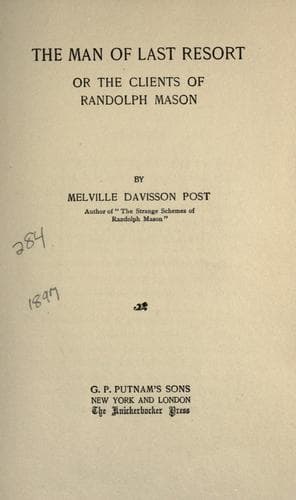
The Man of Last Resort; Or, The Clients of Randolph MasonPost, Melville Davisson
General
The Man of Last Resort; Or, The Clients of Randolph Mason
Post, Melville Davisson
American fiction -- 19th century; Detective and mystery stories, American; Legal stories, American
This impression arose from the fact that the stranger adhered to the
railroad and the coal towns which sprang up in its wake, and in these
every man came from somewhere. The railroad had brought in the coal
companies, and the coal companies had brought in the negroes, and thus
towns sprang into existence, and the usual rough, expeditious methods
of civilization began. Then came the politician and the adventurer, and
mixed in merrily, and from that time forth the county of McDowell was
industrial and Republican, and everything “went.” But a few years back,
before the section hands on the Norfolk and Western Railroad cut through
from the county of Mercer, there was a population in McDowell that was
not Republican, and that did not “go.” They were long-limbed, indolent,
and “handy men” in a fight. They made corn whiskey when they pleased,
and voted the Democratic ticket when they saw fit, and accounted to
no one. The revenue officer came, and looked up at the great mountains
covered with the giant oaks of a century, concluded that the laws were
not being violated, and so reported to the Government. It was vastly
more comfortable than going up into these same mountains not to come
down at all, or maybe to come down with a squirrel bullet under the
ribs. In his day and generation the revenue officer was a wise man.
Here the citizen was born as it happened, lived as he could, and died
as the necessity arose, and the outside world neither knew nor cared nor
concerned itself with it. These were not bad people. Morally they were
as good as the sun warmed. Their life bred no shams. If they loved each
other, they lived together and were happy, and if they hated each other,
they fought it out The feud has been usually overdrawn. It existed in
truth, but it rarely resulted in anything more than a “fist fight” at a
grist mill, but when it grew serious, it grew very serious indeed. The
mountaineer always shot to kill. He was no man of half measures; it was
a free, open, breezy war, and perhaps it was as healthy fighting as any.
At his worst, the native moonshiner was a better man than the imported
miner at his best. Up in the fog of the mountains men were killed; down
in the smoke of the coke ovens they were murdered; and between the two
words there is a distinction as big as the honor of a people.
The “killer” was common in McDowell, but the suicide was not, perhaps
because men rarely take their own lives in the mountains. It is a
trick of jaded civilization obtaining in congested cities, unknown and
unpractised by the dwellers among the hills. Men died in the mountains,
but by the hand of others.
Public-domain text, read in full here on John Shaqi.
Reviews
Reviews
No reviews yet
Be the first to share your thoughts on this work.
Join the Discussion
Join the discussion
Sign in to leave a comment or review.
Sign InorCreate an account