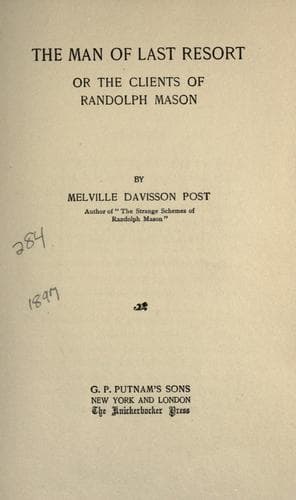
The Man of Last Resort; Or, The Clients of Randolph MasonPost, Melville Davisson
General
The Man of Last Resort; Or, The Clients of Randolph Mason
Post, Melville Davisson
American fiction -- 19th century; Detective and mystery stories, American; Legal stories, American
It was a stiff shock, but the spine of young Mr. Huron was good, and
instead of stepping off the pier, at ten o'clock of that same night
he was demonstrating to a certain wealthy senator who had large
coal interests in West Virginia that it would be the part of no
inconsiderable wisdom to send a bright young fellow with a legal
education down into this great mining region for the purpose of
investigating the land titles, and for the purpose of keeping an eye
on the industries generally, and, as it is said in the law, “for other
purposes.”
The old senator was by no means blind to the very slight efficiency
of raw material, but he had a heart hidden away under his coat, and at
thirty minutes past eleven he was convinced. So J. E. B. Huron came into
the county of McDowell, nailed up his shingle, and stepped down into the
_melée_.
The opening chapters of his legal career were blue-tinted histories, but
the material in the backbone of young Mr. Huron was splendid material,
and he remained. The perception of this man of the law was no dwarfish
growth, and he used it like the wise. McDowell was Republican by 1600,
and “White” Carter was big boss; _post hoc ergo propter hoc_. J. E. B.
Huron was a Republican of ancient affiliation, and more specifically
he was right hand man to White Carter. This wisdom was not without its
reward. The convention that nominated Carter for sheriff, nominated
Huron for prosecuting attorney, and the big boss pulled his man through
in spite of splits, and splits, and independent tickets. The prosecuting
attorney was a handsome young fellow with a good level head. He knew the
value of the sheriff, and he held to him.
The prosecuting attorney took some papers from the safe, drew up a
chair, and sat down by the sheriff.
“You have heard of Hirst's suicide?” he said.
The sheriff nodded. “All but the antemortem note,” he drawled.
The prosecuting attorney smiled. “How did you know there was a note?”
“Jeb,” said the sheriff, “it is a part of the etiquette of suicide. No
man effects his exit without a parting word. It would be bad form, Jeb,
frightfully bad form.”
“So you guessed it?”
“No,” replied the sheriff, wearily, “my gray matter was allowed me for
the purpose of utility. I concluded.”
The prosecuting attorney selected a letter from the package of papers
and passed it over to the sheriff. That official examined the envelope
carefully, then he slowly opened it and spread the enclosed letter out
on the desk before him.
“Octagon Coal Company,” he read slowly, “Miners and Shippers of Coal
and Coke, Welch, West Virginia. Robert Gilmore, President. Brown Hirst,
Business Manager. All agreements are contingent upon strikes, accidents,
and other delays unavoidable or beyond our control.”
The sheriff paused for a moment. “Written at the office,” he observed,
“with a pen, on the company's stationery.”
The guardian of order removed his eyeglasses, wiped them carefully,
replaced them on his nose, and continued:
Public-domain text, read in full here on John Shaqi.
Reviews
Reviews
No reviews yet
Be the first to share your thoughts on this work.
Elsewhere in the archive
Join the Discussion
Join the discussion
Sign in to leave a comment or review.
Sign InorCreate an account