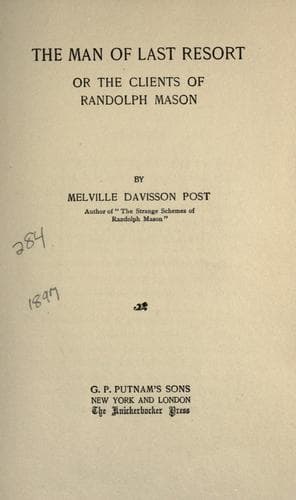
The Man of Last Resort; Or, The Clients of Randolph MasonPost, Melville Davisson
General
The Man of Last Resort; Or, The Clients of Randolph Mason
Post, Melville Davisson
American fiction -- 19th century; Detective and mystery stories, American; Legal stories, American
“The officers of the law are informed that I, Brown Hirst, have taken my
own life, deliberately and at a time when I am in the full possession of
my faculties. My reasons for so doing are of no importance to the law,
and are accordingly withheld. This statement is made merely for
the purpose of preventing any inference of murder, and for no other
purpose.--Brown Hirst.”
The sheriff replaced the letter in its envelope. “That,” he said, “Is a
sensible communication. By the very highest flame on the altar of folly,
it is an exceedingly sensible communication. Where did you find it?”
“The coat and vest,” replied the lawyer, “were found lying carefully
folded over the railing of the bridge. This letter was in the breast
pocket of the coat. Hirst evidently went about his death with great
deliberation. Still, I see no motive for suicide.”
“Jeb,” drawled the sheriff, “you are _long_ on motives. Everything must
have a motive stamped in red ink on its face. Can't you allow an obscure
citizen to change his permanent residence and retain his reasons? The
gentleman has said in his communication that his reasons are of no
moment to the law. Can't you take the gentleman's word for it? It is n't
courteous, Jeb. By the way, where is the corpse of the decedent?”
“Within the sacred jurisdiction of the coroner.”
“And the medical fraternity?” inquired the sheriff.
“Doctor Hart is over in Jacktown putting the finishing touches, it is
said, on old Pap Dolan, so the coroner called in a miracle doctor from
Cincinnati.”
The sheriff chuckled. “Miracle doctor,” he drawled, “is good--is very
good.”
The prosecuting attorney assumed the air of an instructor.
“Healers,” he began, “may be set down, for the purposes of a proper
classification, under three great heads or grand divisions, namely,
'yarb doctors,' 'old-line practitioners,' and 'miracle doctors.' Under
the first class may be grouped those persons who seek to effect cures
by means of the virtues of shrubbery, as well as that vast army of rural
healers known along the watershed of the Alleghanies as 'bleeders' and
'steamers.' Under the second great division are included those grave
professional persons supposed to be learned in the mysteries of the
human economy, who, for a fixed consideration, guess at the ill, and
thrust in a chemical: while the third and final division is composed of
those mysterious healers who affect to thwart dissolution by means of
marvellous knowledge or marvellous skill peculiar to themselves.
“The species of the first grand division infest all that great tract of
country bounded by a timber line. The second great class obtains in the
cities and villages, and affect buggies, drugs, and sombre dress.
The third class is a by-product of congested civilization, and begins
usually with a patent lotion, and ends usually with a hospital.”
White Carter waved his fat hand. “But, if your honor, please,” he
interrupted, “what did the miracle doctor say?”
Public-domain text, read in full here on John Shaqi.
Reviews
Reviews
No reviews yet
Be the first to share your thoughts on this work.
Elsewhere in the archive
Join the Discussion
Join the discussion
Sign in to leave a comment or review.
Sign InorCreate an account