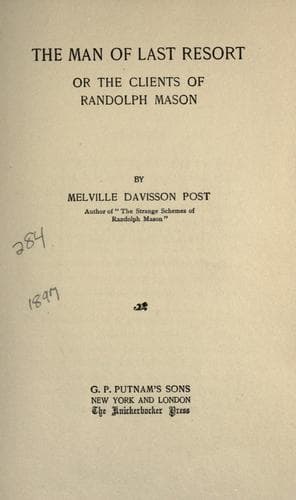
The Man of Last Resort; Or, The Clients of Randolph MasonPost, Melville Davisson
General
The Man of Last Resort; Or, The Clients of Randolph Mason
Post, Melville Davisson
American fiction -- 19th century; Detective and mystery stories, American; Legal stories, American
“He said,” replied the prosecuting attorney, “that Brown Hirst was a
compound fracture from the sustentaculum tali to the tripod of Haller;
and from the tripod of Haller to the corpus callossum, he was a simple
fracture.”
“Horrible,” drawled the sheriff.
“And he said further,” continued the man of the law, “that the
suiciding decedent was probably afflicted with some species of psychical
neurosis.”
“_Domine miserere!_” murmured the guardian of order. “So the travelling
Æsculapius testified, and as the coroner was quite unable to spell the
craft terms, he simply wrote down in the record that Doctor Leon Dupey
of Cincinnati, after a careful examination, had pronounced Brown Hirst
dead, which was far less prolix and entirely true.”
“That coroner,” observed White Carter, “should be United States Senator
from Kansas.”
Huron took up the note and put it with the other papers.
“I judge this to be a plain case of suicide,” he said. “I have carefully
compared the writing with these letters. It is certainly Brown Hirst's
writing. Still, men do not act without a motive, and I see no
justifiable motive.”
“Well,” said the sheriff, “I happen to know that financially the Octagon
Coal Company is somewhat 'groggy.' How will that answer for a motive _ad
interim?_ Or, as the sensible would say, in the meantime?”
“Good,” said the prosecuting attorney. Then he took a pencil from
his pocket, and wrote on the back of the decedent's letter “Suicide.
Motive--business depression,” and replaced the papers in the safe.
The sheriff arose. “The legend you have subscribed is probably correct,”
he drawled, “but the ways of Providence are varied and mystic, and I
think I shall make some observations in my own right.” Then he went out.
II
IT is quite plain,” said Randolph Mason, “that you have fallen into
the usual blunder of the common rogue. If you had wished to rob the
insurance companies, you could easily have accomplished your end without
perpetrating this crime, and thus assume the hazard of discovery and
criminal prosecution.”
Robert Gilmore looked sharply at the counsellor.
“You mean that I am seeking advice late?”
“Precisely,” said Mason. “It is the characteristic error of the
witless.”
“Well,” observed the coal operator, “in desperate positions one usually
relies on one's-self; confederates are dangerous, and usually expert
advice is difficult to obtain.” Then he laughed. “I could not advertise
for sealed bids on how the thing should be done. I did the best possible
under the circumstances, and I rather thought that I had made a clean
job of it.”
“That delusion,” muttered Mason, “is common with the amateur. Indeed, it
is the mark of him. This killing was useless. You could have gotten on as
well without it.”
The keen, gray eyes of Robert Gilmore twinkled. “I should be interested
to know how?” he said.
Public-domain text, read in full here on John Shaqi.
Reviews
Reviews
No reviews yet
Be the first to share your thoughts on this work.
Elsewhere in the archive
Join the Discussion
Join the discussion
Sign in to leave a comment or review.
Sign InorCreate an account