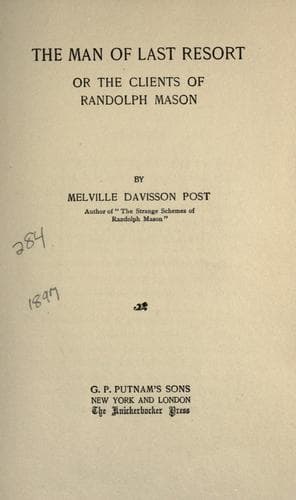
The Man of Last Resort; Or, The Clients of Randolph MasonPost, Melville Davisson
General
The Man of Last Resort; Or, The Clients of Randolph Mason
Post, Melville Davisson
American fiction -- 19th century; Detective and mystery stories, American; Legal stories, American
“I guess it was a sort of Providential judgment,” he continued, “if such
things are supposed to be in this practical time. I avoided the woman
as far as possible, and strove to conceal my terrible regret, but it was
quite useless. Hirst knew almost before I realized the feeling myself,
and harshly bade me remember that this was business, and no matter of
maudlin sentiment. He had no feeling whatever for the woman, and if I
could wait for a little time the plan would very shortly give her to me.
He warned me against what he was pleased to call 'nonsense,' and I must
admit that the powerful personality of this man forced me into a sort of
stolid subjection to his will. But the feeling for the woman remained,
and I hated Hirst.”
Randolph Mason put out his hand as though to interrupt the speaker, but,
appearing to reconsider, suddenly withdrew it and nodded to the coal
operator to continue. The young man took no notice of the interruption.
“Hirst,” he went on, “like the master spirit that he was, proceeded to
put the details of his plan into operation. From time to time he applied
to the best companies in the country for insurance, and as he was
considered a good risk, a man of fine physique, and in charge of a
substantial business, he presently secured about two hundred thousand
dollars on his life. These policies he carried for two years in order
to avoid the suicide clause, and in order to render them as nearly
incontestable as possible.
“Finally, every arrangement having been completed, the time drew near
when Brown Hirst determined to make the final movement in his scheme.
But during these two years my hate of this man had not been idle. I
don't know just what possessed me. I had no good reason to hate him.
It was all, as he said, a business matter,--details in a pure business
matter. But I did hate him, and, unconsciously, one does not know just
how. I determined to take a part in his plan. I determined to make the
play real. This determination was no sudden resolve; it seemed rather
to evolve slowly until it finally became a fixed purpose. The motive
for the supposed suicide, Hirst had by no means overlooked. It was to be
impending financial ruin, and during the past year immediately preceding
his death Brown Hirst drew great sums from the business, and finally
mortgaged and remortgaged the entire coal plant and applied the money
to the payment of his heavy insurance, so that at the time of his
disappearance the business would be in a state of financial collapse,
and the motive for his rash deed would be adequate and thoroughly
apparent.
Public-domain text, read in full here on John Shaqi.
Reviews
Reviews
No reviews yet
Be the first to share your thoughts on this work.
Elsewhere in the archive
Join the Discussion
Join the discussion
Sign in to leave a comment or review.
Sign InorCreate an account