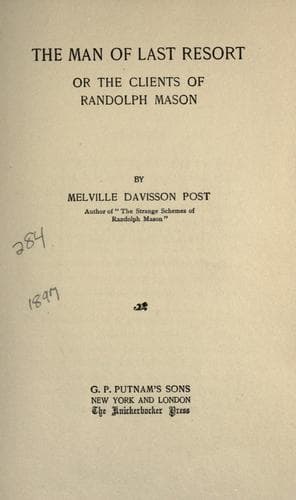
The Man of Last Resort; Or, The Clients of Randolph MasonPost, Melville Davisson
General
The Man of Last Resort; Or, The Clients of Randolph Mason
Post, Melville Davisson
American fiction -- 19th century; Detective and mystery stories, American; Legal stories, American
“During all this time, Hirst operated in McDowell near the county seat
of Welch, his wife remaining for the most part with her father, while I
maintained a city office in Philadelphia. On the day set apart for the
disappearance of Brown Hirst, there was a stockholders' meeting of our
company at its principal office in West Virginia. It was a sham, but it
was rumored that the purpose of this meeting was to discuss some measure
that would relieve our business from impending ruin. This was the
purpose made public. The real purpose was to account for my presence
in McDowell. It was a part of Hirst's plan that I should remain behind
after his disappearance in order to see that everything was properly
arranged, and then take a night train for the East.
“The preliminary details of that night's work were splendidly managed.
We met together at the office of the company. Here Hirst wrote a letter
explaining that he was about to take his own life, and placed it in the
pocket of his coat.
“Then he took a bundle of men's clothing, in which he intended to make
his escape from the country. This bundle consisted of a grimy coat such
as the ordinary miner wears, in the pockets of which he had placed a
package of bank notes, a pocket-book containing a New York draft and a
memorandum of his insurance policies.
“The trousers, shoes, and other articles of this disguise Hirst wore
when he left the office, it being his intention to leave his usual coat
and vest on the bridge over Tug River, as evidence of the suicide, and
then, assuming the remainder of his disguise, slip out to Cincinnati on
the night freight.
“From the office we went directly to the bridge over Tug River, for the
reason, as Brown Hirst always maintained, that in order to leave perfect
circumstantial evidence it was absolutely necessary to actually do as
far as possible the things which one desired the public to believe one
had done.
“It was perhaps two o'clock, and very dark and wet. It had been raining
for almost a week. This was largely in our favor, since the river
at flood is deep and rapid, and a body lost in it when the water was
running high would not probably be recovered at all, as we had noticed
was the case with lumbermen not infrequently drowned; hence we had
selected the time of heaviest rains in this region in order that the
loss of the body should not seem a matter of unusual moment.
“It might be as well to explain that when Tug River is swollen by rains
its channel beneath the bridge is very deep and rapid nearest its east
shore, while near the west shore its bed is higher and covered with
immense bowlders; thus anything thrown into this river on its east
side would probably be carried away and lost, while if dropped from the
bridge on the west side it would probably lodge among the bowlders, and
remain after the high water had subsided.
Public-domain text, read in full here on John Shaqi.
Reviews
Reviews
No reviews yet
Be the first to share your thoughts on this work.
Elsewhere in the archive
Join the Discussion
Join the discussion
Sign in to leave a comment or review.
Sign InorCreate an account