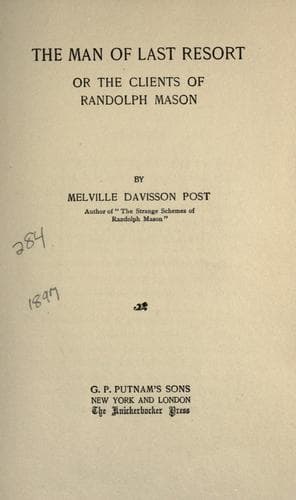
The Man of Last Resort; Or, The Clients of Randolph MasonPost, Melville Davisson
General
The Man of Last Resort; Or, The Clients of Randolph Mason
Post, Melville Davisson
American fiction -- 19th century; Detective and mystery stories, American; Legal stories, American
It is the function of bodies of this sort to be severe, and it is their
way to be most amiable. The prosecuting attorney, it was maintained,
ought to know what he wanted. He was paid to know. It was his business.
If he thought it wise to send in witnesses charging one with a crime,
then the charge should be found. This conclusion was a splendid working
hypothesis, pregnant with expedition, but not quite in accord with the
ideal _jus_.
So the grand jury rested as the afternoon grew apace, while the
scripturian from Charity Fork toiled, and the prosecuting attorney
went down to his office in order to “see if there was anything else he
wanted.” It was at this hour of lull, that a nervous little man hurried
into the office presided over by the industrious daughter of the house
of McFadden, and inquired for Mr. Huron. The red genius replied that he
was busy. According to this oracle, young Mr. Huron was always busy. His
continual status was one of tireless toil,--as continuous as a mortgage,
and as tireless as a gas meter.
Just then the prosecuting attorney came out on his way to the grand jury
room. The little man rushed up and demanded an immediate audience. The
two returned to the private office and closed the door. Here the little
man looked at his watch and announced that things would have to
be rushed, and launched into the subject. He explained with almost
breathless rapidity that he was a detective from New York, representing
Loomey's Agency. As he talked, he threw back his coat revealing a
badge which Mr. Huron did not stop to examine. He said that he had been
working on the case of Brown Hirst; that he had finally discovered
that Hirst had been murdered, foully murdered by one Robert Gilmore,
president of the Octagon Coal Company; that he had the case tightened
around Gilmore beyond the remotest shadow of probability; that Gilmore,
it seemed, had by some means learned of the damning evidence gathering
against him, and was attempting to fly from the country; that he had
left Philadelphia disguised as a cattle drover, and would pass through
Chares-ton, West Virginia, at midnight on the Chesapeake and Ohio
Railroad, and if he was not then arrested, he would probably escape
entirely, or, at the least, subject his trailer to the expense and the
tedium of an extradition; hence the detective had hurried to Welch in
order to secure an indictment at once and return to Charleston in a
position to arrest the man and hold him under a legal warrant that would
be valid and unquestioned.
He explained that he must leave at three o'clock in order to reach the
Chesapeake and Ohio Railroad in time, and requested that he be permitted
to go at once before the grand-jury, which he had learned was now in
session.
Public-domain text, read in full here on John Shaqi.
Reviews
Reviews
No reviews yet
Be the first to share your thoughts on this work.
Elsewhere in the archive
Join the Discussion
Join the discussion
Sign in to leave a comment or review.
Sign InorCreate an account