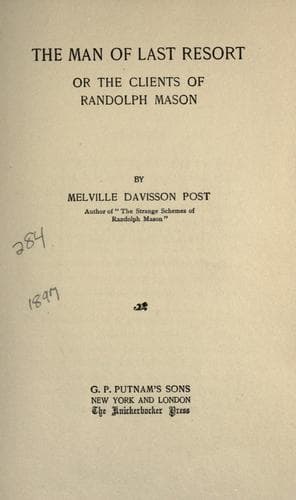
The Man of Last Resort; Or, The Clients of Randolph MasonPost, Melville Davisson
General
The Man of Last Resort; Or, The Clients of Randolph Mason
Post, Melville Davisson
American fiction -- 19th century; Detective and mystery stories, American; Legal stories, American
Over by the window stood a prisoner in the custody of the marshal.
The man was poor, miserably poor; his clothes were clean, threadbare,
ancient as the law. Carper knew the story. The man was a little
shopkeeper; his wife was ill,--dying, the deputy said. There were
children, too, hungry, naked, absurdly miserable, and the crime,--some
petty revenue infraction. He would be presently required to pay his
fine, and, failing that, would be locked up in a cell. It was the law,
heartless as an image. Yet Carper wondered listlessly if one from beyond
the world's rim on the quest of the good would not take this man, and
leave the others, leave all the others--the judge with his blue-veined
patriciate face, the clerks with their lank jaws, the attorneys, with
their expression of abominable indifference, and himself. Well, the
machinery of human justice was awry. Then he wondered at the condition
that bred this surmise. How was it possible to reflect so indolently
upon the condition of another when his own was perilous. Still, such
speculations obtained with men, it is said, in great crises, and at the
grave's edge.
Presently the judge laid down his papers and began to speak. Carper
heard him as one speaking a long distance away. At first the words
seemed indistinct and without meaning; then he caught them full, as one
waking suddenly catches and understands the conversation of his fellow.
“Our commissioner's report,” the judge was saying, “shows that this
receiver has now in his custody three hundred and seventeen thousand
dollars belonging to the stockholders of the Massachusetts Iron Company.
At a former term of this court an order was entered directing the
receiver to distribute this fund in accordance with a previous decree.
At that term this order was resisted upon the ground that the decree
was not sufficiently explicit; which objection the court, upon
consideration, overruled. Later, the payment was sought to be held back
upon the ground that this order was improvidently awarded, and a motion
made to revoke, which was also overruled. And still later innumerable
technical objections have been offered by the attorney for the receiver,
all of which this court considers insufficient and trivial.”
At this point one of the attorneys for Carper arose. “If your honor
please,” he said, “we ask to be heard in defense of our client. We think
that it can yet be shown that this order should not be enforced.” Then
he sat down.
The blue veins in the face of the jurist grew darker. “Gentlemen,” he
continued, “cannot now be heard. The time of this court has already been
much consumed by unprofitable argument. On yesterday the stockholders
of the Massachusetts Iron Company applied for a rule, requiring Russell
Carper, receiver, to appear and make answer, if any he has, why he
should not be attached and punished for contempt in disobeying the
orders of this court. The rule I have ordered to issue returnable
tomorrow morning at ten o'clock.”
Public-domain text, read in full here on John Shaqi.
Reviews
Reviews
No reviews yet
Be the first to share your thoughts on this work.
Elsewhere in the archive
Join the Discussion
Join the discussion
Sign in to leave a comment or review.
Sign InorCreate an account