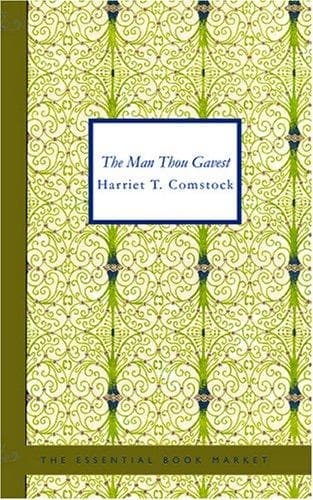
The Man Thou GavestComstock, Harriet T. (Harriet Theresa)
General
The Man Thou Gavest
Comstock, Harriet T. (Harriet Theresa)
Fiction
"I've found an old man and woman, near by," Betty said one day, "they
were afraid they would have to go to the poor-house, although both are
able to do a little. I'm going to put them in my bungalow--the two
little upstair rooms shall be theirs. When I run down to find myself it
will be homey to see the two shining, old faces there to greet me. They
are not a bit cringing; I think they know how much they will mean to me.
They consider me rather immoral, I know, but that doesn't matter."
And then in early October Brace and Betty were married in the church
across the river. Red and gold autumn leaves were falling where earlier
the roses had clambered; it was a brisk, cool day full of sun and shade
and the wedding was more to the old clergyman's taste. The organist was
in his place, his music discriminately chosen, there were guests and
flowers and discreet costumes.
"More as it should be," thought the serene pastor; but Lynda missed the
kindly old woman who had drifted in on her wedding day, and the small,
tearful girl who had wanted her mother.
CHAPTER XVII
There are spaces in all lives that seem so surrounded by safety and
established conditions that one cannot conceive of change. Those
particular spots may know light and shade of passing events but it seems
that they cannot, of themselves, be affected. So Truedale and Lynda had
considered their lives at that period. They were supremely happy, they
were gloriously busy--and that meant that they both recognized
limitations. They took each day as it came and let it go at the end with
a half-conscious knowledge that it had been too short.
Then one late October afternoon Truedale tapped on the door of Lynda's
workshop and to her cheery "come," entered, closed the door after him,
and sat down. He was very white and sternly serious. Lynda looked at him
questioningly but did not speak.
"I've seen Dr. McPherson," Conning said presently, "he sent for me. He's
been away, you know."
"I had not known--but--" Then Lynda remembered!
"Lynda, did you know--of my uncle's--will before his death?"
"Why, yes, Con."
Something cold and death-like clutched Lynda's heart. It was as if an
icy wave had swept warmth and safety before it, leaving her aghast and
afraid.
"Yes, I knew."
"Will you tell me--I could not go into this with McPherson, somehow; he
didn't see it my way, naturally--will you tell me what would have become
of the--the fortune had I not married you?"
The deathly whiteness of Lynda's face did not stay Truedale's hard
words; he was not thinking of her--even of himself; he was thinking of
the irony of fate in the broad sense.
"The money would have--come to me." Then, as if to divert any further
misunderstanding. "And when I refused it--it would have reverted to
charities."
Public-domain text, read in full here on John Shaqi.
Reviews
Reviews
No reviews yet
Be the first to share your thoughts on this work.
Elsewhere in the archive
Join the Discussion
Join the discussion
Sign in to leave a comment or review.
Sign InorCreate an account