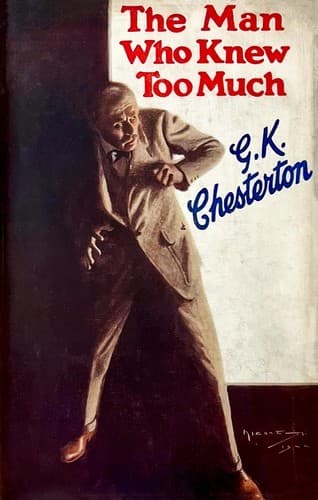
The Man Who Knew Too MuchChesterton, G. K. (Gilbert Keith)
ReligionComparative
The Man Who Knew Too Much
Chesterton, G. K. (Gilbert Keith)
Aristocracy (Social class) -- Fiction; Detective and mystery stories, English; Great Britain -- Fiction
With that he turned his back, evidently resolved to say no more, and
walked past the temple to the extreme end of the islet, where he
stood staring into the water. Fisher followed him, but, when his
repeated questions evoked no answer, turned back toward the shore.
In doing so he took a second and closer look at the artificial
temple, and noted some curious things about it. Most of these
theatrical things were as thin as theatrical scenery, and he
expected the classic shrine to be a shallow thing, a mere shell or
mask. But there was some substantial bulk of it behind, buried in
the trees, which had a gray, labyrinthian look, like serpents of
stone, and lifted a load of leafy towers to the sky. But what
arrested Fisher's eye was that in this bulk of gray-white stone
behind there was a single door with great, rusty bolts outside; the
bolts, however, were not shot across so as to secure it. Then he
walked round the small building, and found no other opening except
one small grating like a ventilator, high up in the wall. He
retraced his steps thoughtfully along the causeway to the banks of
the lake, and sat down on the stone steps between the two sculptured
funeral urns. Then he lit a cigarette and smoked it in ruminant
manner; eventually he took out a notebook and wrote down various
phrases, numbering and renumbering them till they stood in the
following order: "(1) Squire Hawker disliked his first wife. (2) He
married his second wife for her money. (3) Long Adam says the estate
is really his. (4) Long Adam hangs round the island temple, which
looks like a prison. (5) Squire Hawker was not poor when he gave up
the estate. (6) Verner was poor when he got the estate."
He gazed at these notes with a gravity which gradually turned to a
hard smile, threw away his cigarette, and resumed his search for a
short cut to the great house. He soon picked up the path which,
winding among clipped hedges and flower beds, brought him in front
of its long Palladian facade. It had the usual appearance of being,
not a private house, but a sort of public building sent into exile
in the provinces.
He first found himself in the presence of the butler, who really
looked much older than the building, for the architecture was dated
as Georgian; but the man's face, under a highly unnatural brown wig,
was wrinkled with what might have been centuries. Only his prominent
eyes were alive and alert, as if with protest. Fisher glanced at
him, and then stopped and said:
"Excuse me. Weren't you with the late squire, Mr. Hawker?"
"Yes, sir," said the man, gravely. "Usher is my name. What can I do
for you?"
"Only take me into Sir Francis Verner," replied the visitor.
Public-domain text, read in full here on John Shaqi.
Reviews
Reviews
No reviews yet
Be the first to share your thoughts on this work.
Elsewhere in the archive
Join the Discussion
Join the discussion
Sign in to leave a comment or review.
Sign InorCreate an account