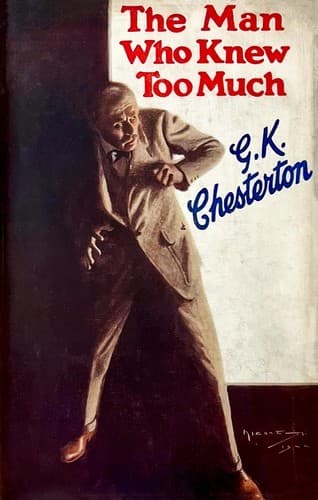
The Man Who Knew Too MuchChesterton, G. K. (Gilbert Keith)
ReligionComparative
The Man Who Knew Too Much
Chesterton, G. K. (Gilbert Keith)
Aristocracy (Social class) -- Fiction; Detective and mystery stories, English; Great Britain -- Fiction
With the electric torch in his hand he struck the foremost of them
so furiously in the face that the man stumbled and rolled over on
the slimy grass; but the torch was broken and extinguished, leaving
everything in a denser obscurity. He flung another man flat against
the temple wall, so that he slid to the ground; but a third and
fourth carried Fisher off his feet and began to bear him,
struggling, toward the doorway. Even in the bewilderment of the
battle he was conscious that the door was standing open. Somebody
was summoning the roughs from inside.
The moment they were within they hurled him upon a sort of bench or
bed with violence, but no damage; for the settee, or whatever it
was, seemed to be comfortably cushioned for his reception. Their
violence had in it a great element of haste, and before he could
rise they had all rushed for the door to escape. Whatever bandits
they were that infested this desert island, they were obviously
uneasy about their job and very anxious to be quit of it. He had the
flying fancy that regular criminals would hardly be in such a panic.
The next moment the great door crashed to and he could hear the
bolts shriek as they shot into their place, and the feet of the
retreating men scampering and stumbling along the causeway. But
rapidly as it happened, it did not happen before Fisher had done
something that he wanted to do. Unable to rise from his sprawling
attitude in that flash of time, he had shot out one of his long legs
and hooked it round the ankle of the last man disappearing through
the door. The man swayed and toppled over inside the prison chamber,
and the door closed between him and his fleeing companions. Clearly
they were in too much haste to realize that they had left one of
their company behind.
The man sprang to his feet again and hammered and kicked furiously
at the door. Fisher's sense of humor began to recover from the
struggle and he sat up on his sofa with something of his native
nonchalance. But as he listened to the captive captor beating on the
door of the prison, a new and curious reflection came to him.
The natural course for a man thus wishing to attract his friends'
attention would be to call out, to shout as well as kick. This man
was making as much noise as he could with his feet and hands, but
not a sound came from his throat. Why couldn't he speak? At first he
thought the man might be gagged, which was manifestly absurd. Then
his fancy fell back on the ugly idea that the man was dumb. He
hardly knew why it was so ugly an idea, but it affected his
imagination in a dark and disproportionate fashion. There seemed to
be something creepy about the idea of being left in a dark room with
a deaf mute. It was almost as if such a defect were a deformity. It
was almost as if it went with other and worse deformities. It was as
if the shape he could not trace in the darkness were some shape that
should not see the sun.
Public-domain text, read in full here on John Shaqi.
Reviews
Reviews
No reviews yet
Be the first to share your thoughts on this work.
Elsewhere in the archive
Join the Discussion
Join the discussion
Sign in to leave a comment or review.
Sign InorCreate an account