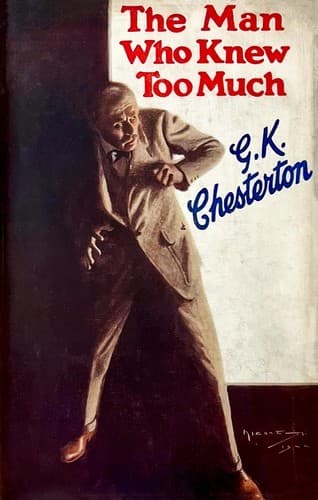
The Man Who Knew Too MuchChesterton, G. K. (Gilbert Keith)
ReligionComparative
The Man Who Knew Too Much
Chesterton, G. K. (Gilbert Keith)
Aristocracy (Social class) -- Fiction; Detective and mystery stories, English; Great Britain -- Fiction
"By the way, is there any news of anything?" asked Harker of Harold
March. "I see you've got an evening paper; one of those enterprising
evening papers that come out in the morning."
"The beginning of Lord Merivale's Birmingham speech," replied March,
handing him the paper. "It's only a paragraph, but it seems to me
rather good."
Harker took the paper, flapped and refolded it, and looked at the
"Stop Press" news. It was, as March had said, only a paragraph. But
it was a paragraph that had a peculiar effect on Sir John Harker.
His lowering brows lifted with a flicker and his eyes blinked, and
for a moment his leathery jaw was loosened. He looked in some odd
fashion like a very old man. Then, hardening his voice and handing
the paper to Fisher without a tremor, he simply said:
"Well, here's a chance for the bet. You've got your big news to
disturb the old man's fishing."
Horne Fisher was looking at the paper, and over his more languid and
less expressive features a change also seemed to pass. Even that
little paragraph had two or three large headlines, and his eye
encountered, "Sensational Warning to Sweden," and, "We Shall
Protest."
"What the devil--" he said, and his words softened first to a
whisper and then a whistle.
"We must tell old Hook at once, or he'll never forgive us," said
Harker. "He'll probably want to see Number One instantly, though it
may be too late now. I'm going across to him at once. I bet I'll
make him forget his fish, anyhow." And, turning his back, he made
his way hurriedly along the riverside to the causeway of flat
stones.
March was staring at Fisher, in amazement at the effect his pink
paper had produced.
"What does it all mean?" he cried. "I always supposed we should
protest in defense of the Danish ports, for their sakes and our own.
What is all this botheration about Sir Isaac and the rest of you? Do
you think it bad news?"
"Bad news!" repeated Fisher, with a sort of soft emphasis beyond
expression.
"Is it as bad as all that?" asked his friend, at last.
"As bad as all that?" repeated Fisher. "Why of course it's as good
as it can be. It's great news. It's glorious news! That's where the
devil of it comes in, to knock us all silly. It's admirable. It's
inestimable. It is also quite incredible."
He gazed again at the gray and green colors of the island and the
river, and his rather dreary eye traveled slowly round to the hedges
and the lawns.
"I felt this garden was a sort of dream," he said, "and I suppose I
must be dreaming. But there is grass growing and water moving; and
something impossible has happened."
Even as he spoke the dark figure with a stoop like a vulture
appeared in the gap of the hedge just above him.
"You have won your bet," said Harker, in a harsh and almost croaking
voice. "The old fool cares for nothing but fishing. He cursed me and
told me he would talk no politics."
"I thought it might be so," said Fisher, modestly. "What are you
going to do next?"
Public-domain text, read in full here on John Shaqi.
Reviews
Reviews
No reviews yet
Be the first to share your thoughts on this work.
Join the Discussion
Join the discussion
Sign in to leave a comment or review.
Sign InorCreate an account