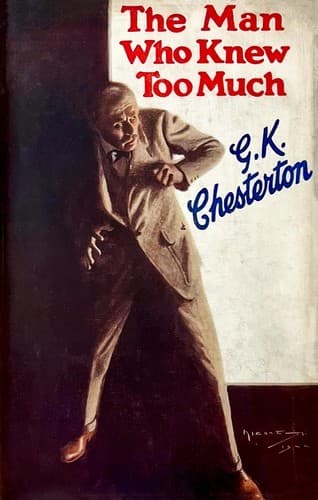
The Man Who Knew Too MuchChesterton, G. K. (Gilbert Keith)
ReligionComparative
The Man Who Knew Too Much
Chesterton, G. K. (Gilbert Keith)
Aristocracy (Social class) -- Fiction; Detective and mystery stories, English; Great Britain -- Fiction
"I shall use the old idiot's telephone, anyhow," replied the lawyer.
"I must find out exactly what has happened. I've got to speak for
the Government myself to-morrow." And he hurried away toward the
house.
In the silence that followed, a very bewildering silence so far as
March was concerned, they saw the quaint figure of the Duke of
Westmoreland, with his white hat and whiskers, approaching them
across the garden. Fisher instantly stepped toward him with the pink
paper in his hand, and, with a few words, pointed out the
apocalyptic paragraph. The duke, who had been walking slowly, stood
quite still, and for some seconds he looked like a tailor's dummy
standing and staring outside some antiquated shop. Then March heard
his voice, and it was high and almost hysterical:
"But he must see it; he must be made to understand. It cannot have
been put to him properly." Then, with a certain recovery of fullness
and even pomposity in the voice, "I shall go and tell him myself."
Among the queer incidents of that afternoon, March always remembered
something almost comical about the clear picture of the old
gentleman in his wonderful white hat carefully stepping from stone
to stone across the river, like a figure crossing the traffic in
Piccadilly. Then he disappeared behind the trees of the island, and
March and Fisher turned to meet the Attorney-General, who was coming
out of the house with a visage of grim assurance.
"Everybody is saying," he said, "that the Prime Minister has made
the greatest speech of his life. Peroration and loud and prolonged
cheers. Corrupt financiers and heroic peasants. We will not desert
Denmark again."
Fisher nodded and turned away toward the towing path, where he saw
the duke returning with a rather dazed expression. In answer to
questions he said, in a husky and confidential voice:
"I really think our poor friend cannot be himself. He refused to
listen; he--ah--suggested that I might frighten the fish."
A keen ear might have detected a murmur from Mr. Fisher on the
subject of a white hat, but Sir John Harker struck it more
decisively:
"Fisher was quite right. I didn't believe it myself, but it's quite
clear that the old fellow is fixed on this fishing notion by now. If
the house caught fire behind him he would hardly move till sunset."
Fisher had continued his stroll toward the higher embanked ground of
the towing path, and he now swept a long and searching gaze, not
toward the island, but toward the distant wooded heights that were
the walls of the valley. An evening sky as clear as that of the
previous day was settling down all over the dim landscape, but
toward the west it was now red rather than gold; there was scarcely
any sound but the monotonous music of the river. Then came the sound
of a half-stifled exclamation from Horne Fisher, and Harold March
looked up at him in wonder.
"You spoke of bad news," said Fisher. "Well, there is really bad
news now. I am afraid this is a bad business."
Public-domain text, read in full here on John Shaqi.
Reviews
Reviews
No reviews yet
Be the first to share your thoughts on this work.
Join the Discussion
Join the discussion
Sign in to leave a comment or review.
Sign InorCreate an account