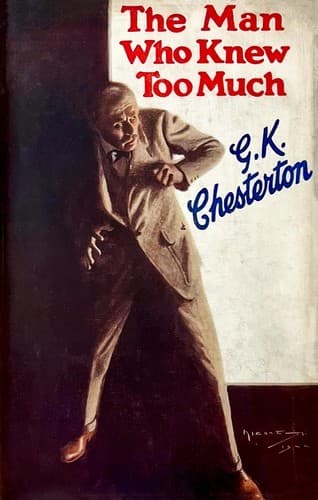
The Man Who Knew Too MuchChesterton, G. K. (Gilbert Keith)
ReligionComparative
The Man Who Knew Too Much
Chesterton, G. K. (Gilbert Keith)
Aristocracy (Social class) -- Fiction; Detective and mystery stories, English; Great Britain -- Fiction
"Because you all look at me like that," cried the young man,
angrily. "Do you think I don't know you're always talking about my
damned debts and expectations?"
Rather to March's surprise, Fisher had drawn away from this first
collision, leading the duke with him to another part of the garden.
When he was out of earshot of the others he said, with a curious
simplicity of manner:
"Westmoreland, I am going straight to the point."
"Well?" said the other, staring at him stolidly.
"You have a motive for killing him," said Fisher.
The duke continued to stare, but he seemed unable to speak.
"I hope you had a motive for killing him," continued Fisher, mildly.
"You see, it's rather a curious situation. If you have a motive for
murdering, you probably didn't murder. But if you hadn't any motive,
why, then perhaps, you did."
"What on earth are you talking about?" demanded the duke, violently.
"It's quite simple," said Fisher. "When you went across he was
either alive or dead. If he was alive, it might be you who killed
him, or why should you have held your tongue about his death? But if
he was dead, and you had a reason for killing him, you might have
held your tongue for fear of being accused." Then after a silence he
added, abstractedly: "Cyprus is a beautiful place, I believe.
Romantic scenery and romantic people. Very intoxicating for a young
man."
The duke suddenly clenched his hands and said, thickly, "Well, I had
a motive."
"Then you're all right," said Fisher, holding out his hand with an
air of huge relief. "I was pretty sure you wouldn't really do it;
you had a fright when you saw it done, as was only natural. Like a
bad dream come true, wasn't it?"
While this curious conversation was passing, Harker had gone into
the house, disregarding the demonstrations of the sulky nephew, and
came back presently with a new air of animation and a sheaf of
papers in his hand.
"I've telephoned for the police," he said, stopping to speak to
Fisher, "but I think I've done most of their work for them. I
believe I've found out the truth. There's a paper here--" He
stopped, for Fisher was looking at him with a singular expression;
and it was Fisher who spoke next:
"Are there any papers that are not there, I wonder? I mean that are
not there now?" After a pause he added: "Let us have the cards on
the table. When you went through his papers in such a hurry, Harker,
weren't you looking for something to--to make sure it shouldn't be
found?"
Harker did not turn a red hair on his hard head, but he looked at
the other out of the corners of his eyes.
"And I suppose," went on Fisher, smoothly, "that is why you, too,
told us lies about having found Hook alive. You knew there was
something to show that you might have killed him, and you didn't
dare tell us he was killed. But, believe me, it's much better to be
honest now."
Harker's haggard face suddenly lit up as if with infernal flames.
Public-domain text, read in full here on John Shaqi.
Reviews
Reviews
No reviews yet
Be the first to share your thoughts on this work.
Join the Discussion
Join the discussion
Sign in to leave a comment or review.
Sign InorCreate an account