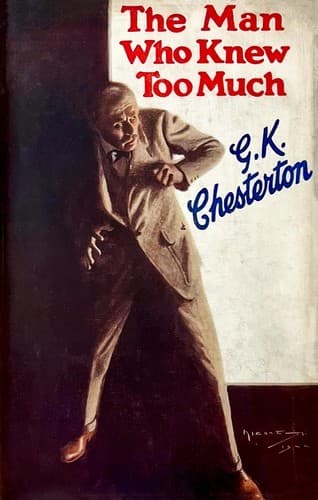
The Man Who Knew Too MuchChesterton, G. K. (Gilbert Keith)
ReligionComparative
The Man Who Knew Too Much
Chesterton, G. K. (Gilbert Keith)
Aristocracy (Social class) -- Fiction; Detective and mystery stories, English; Great Britain -- Fiction
"What bad news do you mean?" asked his friend, conscious of
something strange and sinister in his voice.
"The sun has set," answered Fisher.
He went on with the air of one conscious of having said something
fatal. "We must get somebody to go across whom he will really listen
to. He may be mad, but there's method in his madness. There nearly
always is method in madness. It's what drives men mad, being
methodical. And he never goes on sitting there after sunset, with
the whole place getting dark. Where's his nephew? I believe he's
really fond of his nephew."
"Look!" cried March, abruptly. "Why, he's been across already.
There he is coming back."
And, looking up the river once more, they saw, dark against the
sunset reflections, the figure of James Bullen stepping hastily and
rather clumsily from stone to stone. Once he slipped on a stone with
a slight splash. When he rejoined the group on the bank his olive
face was unnaturally pale.
The other four men had already gathered on the same spot and almost
simultaneously were calling out to him, "What does he say now?"
"Nothing. He says--nothing."
Fisher looked at the young man steadily for a moment; then he
started from his immobility and, making a motion to March to follow
him, himself strode down to the river crossing. In a few moments
they were on the little beaten track that ran round the wooded
island, to the other side of it where the fisherman sat. Then they
stood and looked at him, without a word.
Sir Isaac Hook was still sitting propped up against the stump of the
tree, and that for the best of reasons. A length of his own
infallible fishing line was twisted and tightened twice round his
throat and then twice round the wooden prop behind him. The leading
investigator ran forward and touched the fisherman's hand, and it
was as cold as a fish.
"The sun has set," said Horne Fisher, in the same terrible tones,
"and he will never see it rise again."
Ten minutes afterward the five men, shaken by such a shock, were
again together in the garden, looking at one another with white but
watchful faces. The lawyer seemed the most alert of the group; he
was articulate if somewhat abrupt.
"We must leave the body as it is and telephone for the police," he
said. "I think my own authority will stretch to examining the
servants and the poor fellow's papers, to see if there is anything
that concerns them. Of course, none of you gentlemen must leave this
place."
Perhaps there was something in his rapid and rigorous legality that
suggested the closing of a net or trap. Anyhow, young Bullen
suddenly broke down, or perhaps blew up, for his voice was like an
explosion in the silent garden.
"I never touched him," he cried. "I swear I had nothing to do with
it!"
"Who said you had?" demanded Harker, with a hard eye. "Why do you
cry out before you're hurt?"
Public-domain text, read in full here on John Shaqi.
Reviews
Reviews
No reviews yet
Be the first to share your thoughts on this work.
Join the Discussion
Join the discussion
Sign in to leave a comment or review.
Sign InorCreate an account