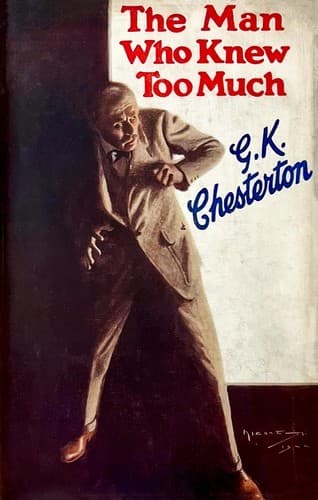
The Man Who Knew Too MuchChesterton, G. K. (Gilbert Keith)
ReligionComparative
The Man Who Knew Too Much
Chesterton, G. K. (Gilbert Keith)
Aristocracy (Social class) -- Fiction; Detective and mystery stories, English; Great Britain -- Fiction
Horne Fisher and Harold March had their day on the river, after all,
for the little group broke up when the police arrived. They declared
that the coincidence of March's evidence had cleared the whole
company, and clinched the case against the flying Hugo. Whether that
Hungarian fugitive would ever be caught appeared to Horne Fisher to
be highly doubtful; nor can it be pretended that he displayed any
very demoniac detective energy in the matter as he leaned back in
the boat cushions, smoking, and watching the swaying reeds slide
past.
"It was a very good notion to hop up on to the bridge," he said. "An
empty boat means very little; he hasn't been seen to land on either
bank, and he's walked off the bridge without walking on to it, so to
speak. He's got twenty-four hours' start; his mustaches will
disappear, and then he will disappear. I think there is every hope
of his escape."
"Hope?" repeated March, and stopped sculling for an instant.
"Yes, hope," repeated the other. "To begin with, I'm not going to
be exactly consumed with Corsican revenge because somebody has
killed Hook. Perhaps you may guess by this time what Hook was. A
damned blood-sucking blackmailer was that simple, strenuous,
self-made captain of industry. He had secrets against nearly
everybody; one against poor old Westmoreland about an early marriage
in Cyprus that might have put the duchess in a queer position; and
one against Harker about some flutter with his client's money when
he was a young solicitor. That's why they went to pieces when they
found him murdered, of course. They felt as if they'd done it in a
dream. But I admit I have another reason for not wanting our
Hungarian friend actually hanged for the murder."
"And what is that?" asked his friend.
"Only that he didn't commit the murder," answered Fisher.
Harold March laid down the oars and let the boat drift for a moment.
"Do you know, I was half expecting something like that," he said.
"It was quite irrational, but it was hanging about in the
atmosphere, like thunder in the air."
"On the contrary, it's finding Hugo guilty that's irrational,"
replied Fisher. "Don't you see that they're condemning him for the
very reason for which they acquit everybody else? Harker and
Westmoreland were silent because they found him murdered, and knew
there were papers that made them look like the murderers. Well, so
did Hugo find him murdered, and so did Hugo know there was a paper
that would make him look like the murderer. He had written it
himself the day before."
"But in that case," said March, frowning, "at what sort of unearthly
hour in the morning was the murder really committed? It was barely
daylight when I met him at the bridge, and that's some way above the
island."
"The answer is very simple," replied Fisher. "The crime was not
committed in the morning. The crime was not committed on the
island."
March stared at the shining water without replying, but Fisher
resumed like one who had been asked a question:
Public-domain text, read in full here on John Shaqi.
Reviews
Reviews
No reviews yet
Be the first to share your thoughts on this work.
Elsewhere in the archive
Join the Discussion
Join the discussion
Sign in to leave a comment or review.
Sign InorCreate an account