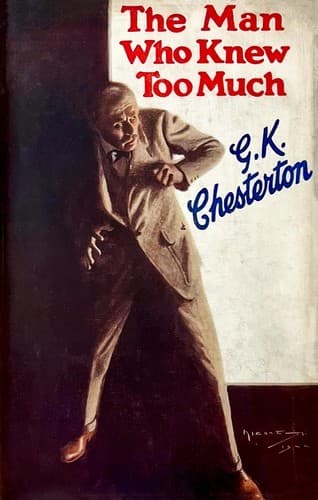
The Man Who Knew Too MuchChesterton, G. K. (Gilbert Keith)
ReligionComparative
The Man Who Knew Too Much
Chesterton, G. K. (Gilbert Keith)
Aristocracy (Social class) -- Fiction; Detective and mystery stories, English; Great Britain -- Fiction
"Every intelligent murder involves taking advantage of some one
uncommon feature in a common situation. The feature here was the
fancy of old Hook for being the first man up every morning, his
fixed routine as an angler, and his annoyance at being disturbed.
The murderer strangled him in his own house after dinner on the
night before, carried his corpse, with all his fishing tackle,
across the stream in the dead of night, tied him to the tree, and
left him there under the stars. It was a dead man who sat fishing
there all day. Then the murderer went back to the house, or, rather,
to the garage, and went off in his motor car. The murderer drove his
own motor car."
Fisher glanced at his friend's face and went on. "You look
horrified, and the thing is horrible. But other things are horrible,
too. If some obscure man had been hag-ridden by a blackmailer and
had his family life ruined, you wouldn't think the murder of his
persecutor the most inexcusable of murders. Is it any worse when a
whole great nation is set free as well as a family? By this warning
to Sweden we shall probably prevent war and not precipitate it, and
save many thousand lives rather more valuable than the life of that
viper. Oh, I'm not talking sophistry or seriously justifying the
thing, but the slavery that held him and his country was a thousand
times less justifiable. If I'd really been sharp I should have
guessed it from his smooth, deadly smiling at dinner that night. Do
you remember that silly talk about how old Isaac could always play
his fish? In a pretty hellish sense he was a fisher of men."
Harold March took the oars and began to row again.
"I remember," he said, "and about how a big fish might break the
line and get away."
VI. THE HOLE IN THE WALL
Two men, the one an architect and the other an archaeologist, met on
the steps of the great house at Prior's Park; and their host, Lord
Bulmer, in his breezy way, thought it natural to introduce them. It
must be confessed that he was hazy as well as breezy, and had no
very clear connection in his mind, beyond the sense that an
architect and an archaeologist begin with the same series of
letters. The world must remain in a reverent doubt as to whether he
would, on the same principles, have presented a diplomatist to a
dipsomaniac or a ratiocinator to a rat catcher. He was a big, fair,
bull-necked young man, abounding in outward gestures, unconsciously
flapping his gloves and flourishing his stick.
"You two ought to have something to talk about," he said,
cheerfully. "Old buildings and all that sort of thing; this is
rather an old building, by the way, though I say it who shouldn't. I
must ask you to excuse me a moment; I've got to go and see about the
cards for this Christmas romp my sister's arranging. We hope to see
you all there, of course. Juliet wants it to be a fancy-dress
affair--abbots and crusaders and all that. My ancestors, I suppose,
after all."
Public-domain text, read in full here on John Shaqi.
Reviews
Reviews
No reviews yet
Be the first to share your thoughts on this work.
Elsewhere in the archive
Join the Discussion
Join the discussion
Sign in to leave a comment or review.
Sign InorCreate an account