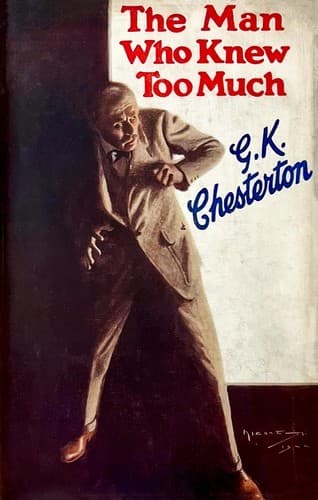
The Man Who Knew Too MuchChesterton, G. K. (Gilbert Keith)
ReligionComparative
The Man Who Knew Too Much
Chesterton, G. K. (Gilbert Keith)
Aristocracy (Social class) -- Fiction; Detective and mystery stories, English; Great Britain -- Fiction
"Let us hope we shall find him as happily employed," remarked the
diplomatist. "In that case the voice must have come out of the
wood."
"I'll swear it didn't come out of the house," said Fisher; and the
two disappeared together into the twilight of wintry trees.
The plantation stood dark against the fiery colors of sunrise, a
black fringe having that feathery appearance which makes trees when
they are bare the very reverse of rugged. Hours and hours afterward,
when the same dense, but delicate, margin was dark against the
greenish colors opposite the sunset, the search thus begun at
sunrise had not come to an end. By successive stages, and to slowly
gathering groups of the company, it became apparent that the most
extraordinary of all gaps had appeared in the party; the guests
could find no trace of their host anywhere. The servants reported
that his bed had been slept in and his skates and his fancy costume
were gone, as if he had risen early for the purpose he had himself
avowed. But from the top of the house to the bottom, from the walls
round the park to the pond in the center, there was no trace of Lord
Bulmer, dead or alive. Horne Fisher realized that a chilling
premonition had already prevented him from expecting to find the man
alive. But his bald brow was wrinkled over an entirely new and
unnatural problem, in not finding the man at all.
He considered the possibility of Bulmer having gone off of his own
accord, for some reason; but after fully weighing it he finally
dismissed it. It was inconsistent with the unmistakable voice heard
at daybreak, and with many other practical obstacles. There was only
one gateway in the ancient and lofty wall round the small park; the
lodge keeper kept it locked till late in the morning, and the lodge
keeper had seen no one pass. Fisher was fairly sure that he had
before him a mathematical problem in an inclosed space. His instinct
had been from the first so attuned to the tragedy that it would have
been almost a relief to him to find the corpse. He would have been
grieved, but not horrified, to come on the nobleman's body dangling
from one of his own trees as from a gibbet, or floating in his own
pool like a pallid weed. What horrified him was to find nothing.
He soon become conscious that he was not alone even in his most
individual and isolated experiments. He often found a figure
following him like his shadow, in silent and almost secret clearings
in the plantation or outlying nooks and corners of the old wall. The
dark-mustached mouth was as mute as the deep eyes were mobile,
darting incessantly hither and thither, but it was clear that Brain
of the Indian police had taken up the trail like an old hunter after
a tiger. Seeing that he was the only personal friend of the vanished
man, this seemed natural enough, and Fisher resolved to deal frankly
with him.
Public-domain text, read in full here on John Shaqi.
Reviews
Reviews
No reviews yet
Be the first to share your thoughts on this work.
Elsewhere in the archive
Join the Discussion
Join the discussion
Sign in to leave a comment or review.
Sign InorCreate an account