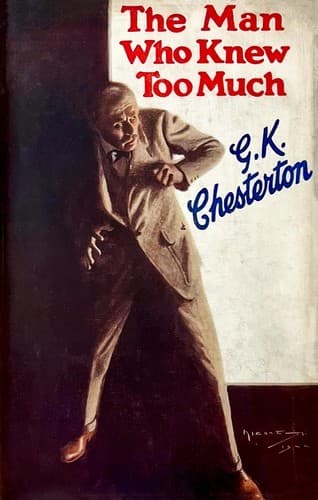
The Man Who Knew Too MuchChesterton, G. K. (Gilbert Keith)
ReligionComparative
The Man Who Knew Too Much
Chesterton, G. K. (Gilbert Keith)
Aristocracy (Social class) -- Fiction; Detective and mystery stories, English; Great Britain -- Fiction
"And I think you're a pack of snobs," said Juliet. "Because Mr.
Crane is a genius who's made his own way, you try to suggest he's a
murderer without daring to say so. Because he wore a toy sword and
happened to know how to use it, you want us to believe he used it
like a bloodthirsty maniac for no reason in the world. And because
he could have hit my brother and didn't, you deduce that he did.
That's the sort of way you argue. And as for his having disappeared,
you're wrong in that as you are in everything else, for here he
comes."
And, indeed, the green figure of the fictitious Robin Hood slowly
detached itself from the gray background of the trees, and came
toward them as she spoke.
He approached the group slowly, but with composure; but he was
decidedly pale, and the eyes of Brain and Fisher had already taken
in one detail of the green-clad figure more clearly than all the
rest. The horn still swung from his baldrick, but the sword was
gone.
Rather to the surprise of the company, Brain did not follow up the
question thus suggested; but, while retaining an air of leading the
inquiry, had also an appearance of changing the subject.
"Now we're all assembled," he observed, quietly, "there is a
question I want to ask to begin with. Did anybody here actually see
Lord Bulmer this morning?"
Leonard Crane turned his pale face round the circle of faces till he
came to Juliet's; then he compressed his lips a little and said:
"Yes, I saw him."
"Was he alive and well?" asked Brain, quickly. "How was he
dressed?"
"He appeared exceedingly well," replied Crane, with a curious
intonation. "He was dressed as he was yesterday, in that purple
costume copied from the portrait of his ancestor in the sixteenth
century. He had his skates in his hand."
"And his sword at his side, I suppose," added the questioner. "Where
is your own sword, Mr. Crane?"
"I threw it away."
In the singular silence that ensued, the train of thought in many
minds became involuntarily a series of colored pictures.
They had grown used to their fanciful garments looking more gay and
gorgeous against the dark gray and streaky silver of the forest, so
that the moving figures glowed like stained-glass saints walking.
The effect had been more fitting because so many of them had idly
parodied pontifical or monastic dress. But the most arresting
attitude that remained in their memories had been anything but
merely monastic; that of the moment when the figure in bright green
and the other in vivid violet had for a moment made a silver cross
of their crossing swords. Even when it was a jest it had been
something of a drama; and it was a strange and sinister thought that
in the gray daybreak the same figures in the same posture might have
been repeated as a tragedy.
"Did you quarrel with him?" asked Brain, suddenly.
"Yes," replied the immovable man in green. "Or he quarreled with
me."
"Why did he quarrel with you?" asked the investigator; and Leonard
Crane made no reply.
Public-domain text, read in full here on John Shaqi.
Reviews
Reviews
No reviews yet
Be the first to share your thoughts on this work.
Elsewhere in the archive
Join the Discussion
Join the discussion
Sign in to leave a comment or review.
Sign InorCreate an account