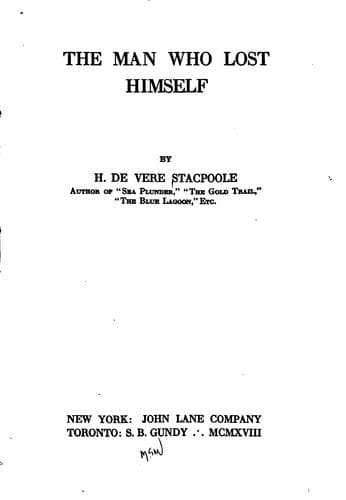
The Man Who Lost HimselfStacpoole, H. De Vere (Henry De Vere)
General
The Man Who Lost Himself
Stacpoole, H. De Vere (Henry De Vere)
Mistaken identity -- Fiction
One great thing about all this Hoover business was the fact that it had
freed him from the haunting dread of those terrible sensations of
duality and negation. Fighting is the finest antidote to nerve troubles
and mental dreads, and he was fighting now for his liberty, for the fact
stood clearly before him, that, whether the Rochester family believed
him to be Rochester or believed him to be Jones, it was to their
interest to hold him as a lunatic in peaceful retirement.
Having breakfasted he lit a cigarette, asked Mrs. Henshaw for a latch
key so that he might not trouble her, put on his panama and went out.
There was a barber's shop across the way, he entered it, found a vacant
chair and was shaved. Then he bought a newspaper and strolled in the
direction of the beach. The idea had come to him that he might be able
to hire a sailing boat and reach London that way, a preposterous and
vague idea that still, however, led him till he reached the esplanade,
and stood with the sea wind blowing in his face.
The only sailing boats visible were excursion craft, guarded by
longshoremen, loading up with trippers, and showing placards to allure
the innocent.
The sands were swarming, and the bathing machines crawling towards the
sea.
He came on to the beach and took his seat on the warm, white sands, with
freedom before him had he been a gull or a fish. To take one of those
cockleshell row boats and scull a few miles down the coast would lead
him where? Only along the coast, rock-strewn beyond the sands and faced
with cliffs. Of boat craft he had no knowledge, the sea was choppy, and
the sailing boats now out seemed going like race horses over hurdles.
No, he would wait till after luncheon, then in that somnolent hour when
all men's thoughts are a bit dulled, and vigilance least awake, he would
find some road, on good hard land, and make his dash.
He would try and get a bicycle map of this part of Wessex. He had
noticed a big stationers' and book-sellers' near the beach, and he would
call there on his way back.
Then he fell to reading his paper, smoking cigarettes, and watching the
crowd.
Watching, he was presently rewarded with the sight of the present day
disgrace of England. Out of a bathing tent, and into the full sunlight,
came a girl with nothing on, for skin tight blue stockinette is nothing
in the eyes of Modesty; every elevation, every depression, every crease
in her shameless anatomy exposed to a hundred pairs of eyes, she walked
calmly towards the water. A young man to match followed. Then they
wallowed in the sea.
Jones forgot Hoover. He recalled Lady Dolly in "Moths"--Lady Dolly, who,
on the beach of Sandbourne-on-Sea would have been the pink of
propriety, and the inhabitants of this beach were not wicked society
people, but respectable middle class folk.
"That's pretty thick," said Jones to an old gentleman like a goat
sitting close to him, whose eyes were fixed in contemplation on the
bathers.
"What?"
Public-domain text, read in full here on John Shaqi.
Reviews
Reviews
No reviews yet
Be the first to share your thoughts on this work.
Elsewhere in the archive
Join the Discussion
Join the discussion
Sign in to leave a comment or review.
Sign InorCreate an account