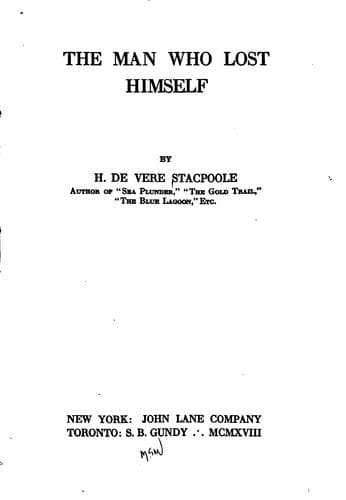
The Man Who Lost HimselfStacpoole, H. De Vere (Henry De Vere)
General
The Man Who Lost Himself
Stacpoole, H. De Vere (Henry De Vere)
Mistaken identity -- Fiction
Sometimes he paused and rested on a gate, listening to the faint and
indeterminate sounds of the night, through which came occasionally the
barking of a distant dog like the beating of a trip hammer.
It was a perfect summer's night, one of those rare nights that England
alone can produce; there were glow worms in the hedges and a scent of
new mown hay in the air. Though the music of the band had been blotted
out by distance, listening intently he caught the faintest suspicion of
a whisper, continuous, and evidently the sound of the sea.
An hour later, that is to say towards eleven o'clock, weary with finding
his way out of fields into fields, into grassy lanes and around farm
house buildings, desperate, and faint from hunger, Jones found a road
and by the road a bungalow with a light in one of the windows.
A dauntingly respectable-looking bungalow in the midst of a well
laid-out garden.
Jones opened the gate and came up the path. He was going to demand food,
offer to pay for it if necessary, and produce gold as an evidence of
good faith.
He came into the verandah, found the front door which was closed, struck
a match, found the bell, pulled and pulled it. There was no response. He
waited a little and then rang again, with a like result. Then he came to
the lighted window.
It was a French window, only half closed, and a half turned lamp showed
a comfortably furnished room and a table laid out for supper.
Two places were set. A cold fowl intact on a dish garnished with parsley
stood side by side with a York ham the worse for wear, a salad, a roll
of cowslip coloured butter, a loaf of home-made bread and a cheese
tucked around with a snow-white napkin made up the rest of the eatables
whilst a decanter of claret shone invitingly by the seat of the carver.
There was nothing wanting, or only the invitation.
The fowl supplied that.
Jones pushed the window open and entered. Half closing it again, he took
his seat at the table placing his hat on the floor beside him. Taking a
sovereign from his pocket, he placed it on the white cloth. Then he fell
to.
You can generally tell a man by his claret, and judging from this claret
the unknown who had supplied the feast must have been a most estimable
man.
A man of understanding and parts, a man not to be deluded by specious
wine lists, a generous warmhearted and full-blooded soul--and here he
was.
A step sounded on the verandah, the window was pushed open and a man of
forty years or so, well-dressed, tall, thin, dark and saturnine stood
before the feaster.
He showed no surprise. Removing his hat he bowed.
Jones half rose.
"Hello," said he confusedly, with his mouth full--then he subsided into
his chair.
"I must apologise for being late," said the tall man, placing his hat on
a chair, rubbing his long hands together and moving to the vacant seat.
"I was unavoidably detained. But I'm glad you did not wait supper."
Public-domain text, read in full here on John Shaqi.
Reviews
Reviews
No reviews yet
Be the first to share your thoughts on this work.
Elsewhere in the archive
Join the Discussion
Join the discussion
Sign in to leave a comment or review.
Sign InorCreate an account