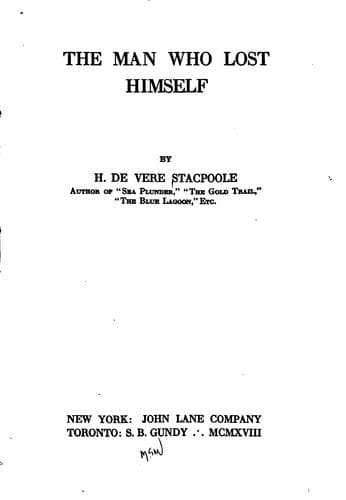
The Man Who Lost HimselfStacpoole, H. De Vere (Henry De Vere)
General
The Man Who Lost Himself
Stacpoole, H. De Vere (Henry De Vere)
Mistaken identity -- Fiction
"Oh, that would make the thing still more difficult, very much more so.
If, of course, he were not conducting himself in a manner detrimental to
the public peace, firing guns out of windows and so forth. The laws of
England are very strict about entering a man's house. Of course, were
the pursuers to go before a magistrate and swear that the pursued were a
dangerous lunatic, then a right of search and entry might be obtained,
but on the pursuers would lie the onus of proof. Now pauper lunatics are
very easily dealt with: the Relieving Officer, on the strength of a
certificate of lunacy, can go to the poor man's cottage or tenement, and
take him away, for, you see, the man possessing no property it is
supposed that no man is interested in his internment, but once
introduce the property element and there is the very devil to pay,
especially in cases where the lunatic is only eccentric and does not
come into court with straws in his hair, so to speak."
"I get you," said Jones. He offered cigarettes, and presently the
communicative one departed, having borrowed fourpence on the strength of
his professional advice.
The rest of that night was a very good imitation of a nightmare. Jones
tried several different seats in succession, and managed to do a good
deal of walking. Dawn found him on London Bridge, watching the birth of
another perfect day, but without enthusiasm.
He was cheerful but tired. The thought that at nine o'clock or
thereabouts, he would be able to place his hands on eight thousand
pounds, gave him the material for his cheerfulness. He had often read of
the joy of open air life, and the freedom of the hobo; but open air life
in London, on looking back upon it, did not appeal to him. He had been
twice moved on by policemen, and his next door neighbours, after the
departure of the barometer man, were of a type that inspired neither
liking nor trust.
He heard Big Ben booming six o'clock. He had three hours still before
him, and he determined to take it out in walking. He would go citywards,
and then come back with an appetite for breakfast.
Having made this resolve, he started, passing through the deserted
streets till he reached the Bank, and then onwards till he reached the
Mile End Road.
As he walked he made plans. When he had drawn his money he would
breakfast at a restaurant, he fixed upon Romanos', eggs and bacon and
sausages, coffee and hot rolls would be the _menu_. Then he fell to
wondering whether Romanos' would be open for breakfast, or whether it
was of the type of restaurant that only serves luncheons and dinners. If
it were, then he could breakfast at the Charing Cross Hotel.
These considerations led him a good distance on his way. Then the Mile
End Road beguiled him, lying straight and foreign looking, and empty in
the sunlight. The Barometer man's weather apparatus must have been at
fault, for in all the sky there was not a cloud, nor the symptom of the
coming of a cloud.
Public-domain text, read in full here on John Shaqi.
Reviews
Reviews
No reviews yet
Be the first to share your thoughts on this work.
Elsewhere in the archive
Join the Discussion
Join the discussion
Sign in to leave a comment or review.
Sign InorCreate an account