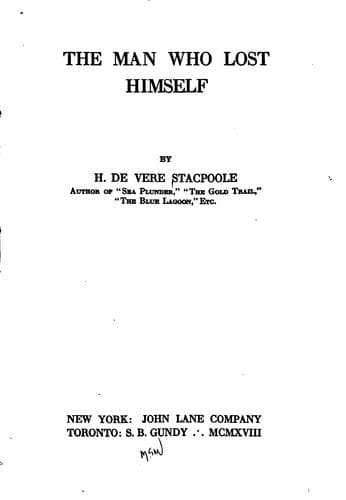
The Man Who Lost HimselfStacpoole, H. De Vere (Henry De Vere)
General
The Man Who Lost Himself
Stacpoole, H. De Vere (Henry De Vere)
Mistaken identity -- Fiction
The prospect of a journey to Paris with this woman in pursuit of another
man's wife was bad enough, but it was not this prospect that made Jones
furious, though assisting. No doubt, it was Venetia herself.
She raised the devil in him, and on the journey to the station, though
she said not a word, she managed to raise his exasperation with the
world, herself, himself and his vile position to the limit just below
the last.--The last was to come.
At the station they walked through the crowd to the booking-office where
Venetia bought the tickets. Reminiscences of being taken on journeys as
a small boy by his mother flitted across the mind of Jones and did not
improve his temper.
He looked at the clock. It wanted twenty minutes of the starting time
and he was in the act of evading a barrow of luggage when Venetia
arrived with the tickets.
It had come into the mind of Jones that not only was he travelling to
Paris with the Hon. Venetia Birdbrook, in pursuit of the wife of another
man, but that they were travelling without luggage. If, in Philadelphia,
he had dreamt of himself in such a position he would have been disturbed
as to the state of his health and the condition of his liver, yet now,
in reality, the thing did not seem preposterous, he was concerned as to
the fact about the want of luggage.
"Look here," said he, "what are we to do--I haven't even a night-suit
of pyjamas. I haven't even a toothbrush. No hotel will take us in."
"We don't want an hotel," said Venetia, "we'll come back straight if we
can save Teresa. If not, if she insists in pursuing her mad course, you
had better not come back at all. Come on and let us take our places in
the train."
They moved away and she continued.
"For if she does you will never be able to hold up your head again,
everyone knows how you have behaved to her."
"Oh, stop it," said he irritably. "I have enough to think about."
"You ought to."
Only just those three words, yet they set him off.
"Ought I? Well, what of yourself? She told me last night things about
_you_."
"About me. What things?"
"Never mind."
"But I do," she stopped and he stopped.
"I mind very much. What things did she tell you?"
"Nothing much, only that you worried the life out of her, and that
though I was bad you were worse."
Venetia sniffed. She was just turning to resume her way to the train
when she stopped dead like a pointer.
"That's them," she said, in a hard, tense whisper.
Jones looked.
A veiled lady accompanied by a bearded man, with a folded umbrella under
his arm and following a porter laden with wraps and small luggage, were
making their way through the crowd towards the train.
The veil did not hide her from him. He knew at once it was she.
It was then that Venetia's effect upon him acted as the contents of the
white-paper acts when emptied into the tumbler that holds the
blue-paper-half of the seidlitz powder.
Venetia saw his face.
"Don't make a scene," she cried.
That was the stirring of the spoon.
Public-domain text, read in full here on John Shaqi.
Reviews
Reviews
No reviews yet
Be the first to share your thoughts on this work.
Elsewhere in the archive
Join the Discussion
Join the discussion
Sign in to leave a comment or review.
Sign InorCreate an account