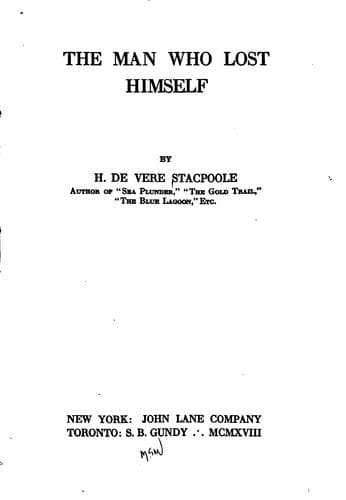
The Man Who Lost HimselfStacpoole, H. De Vere (Henry De Vere)
General
The Man Who Lost Himself
Stacpoole, H. De Vere (Henry De Vere)
Mistaken identity -- Fiction
"Nothing," said Simms, "you are perfectly free, but we don't want you to
go out till your health is perfectly restored. I know, you will say that
you feel all right. No matter, take a physician's advice and just remain
here quiet for a little while. Shall we go to the library where you can
amuse yourself with the newspaper or a book whilst I make up a little
prescription for you?"
"Look here," said Jones. "Let's talk quietly for a moment--you think I'm
mad."
"Not in the least!" said Simms. "You are only suffering from a nerve
upset."
"Well, if I'm not mad you have no right to keep me here."
This was cunning, but, unfortunately, cunning like anger, is an
attribute of madness as well as of sanity.
"Now," said Simms, with an air of great frankness, "do you think that it
is for our pleasure that we ask you to stay here for a while? We are not
keeping you, just asking you to stay. We will go down to the library and
I will just have a prescription made up. Then, when you have considered
matters a bit you can use your own discretion about going."
Jones recognized at once that there was no use in trying to fight this
man with any other weapon than subtlety. He was fairly trapped. His tale
was such that no man would believe it, and, persisting in that tale, he
would be held as a lunatic. On top of the tale was Rochester's bad
reputation for sanity. They called him mad Rochester.
Then as he rose up and followed to the library, a last inspiration
seized him.
He stopped at the drawing-room door.
"Look here," said he, "one moment. I can prove what I say. You send out
a man to Philadelphia and make enquiries, fetch some of the people over
that knew me. You'll find I'm--myself and that I've told you no lie."
"We will do anything you like," said Simms, "but first let us go down to
the library."
They went. It was a large, pleasant room lined with books.
Simms sat down at the writing-table, whilst the others took chairs. He
wrote a prescription, and the Duke, ringing the bell, ordered a servant
to take the prescription to the chemists.
Then during the twenty minutes before the servant returned they talked.
Jones, giving again his address, that fantastic address which was yet
real, and the names and descriptions of people he knew and who would
know him.
Public-domain text, read in full here on John Shaqi.
Reviews
Reviews
No reviews yet
Be the first to share your thoughts on this work.
Elsewhere in the archive
Join the Discussion
Join the discussion
Sign in to leave a comment or review.
Sign InorCreate an account