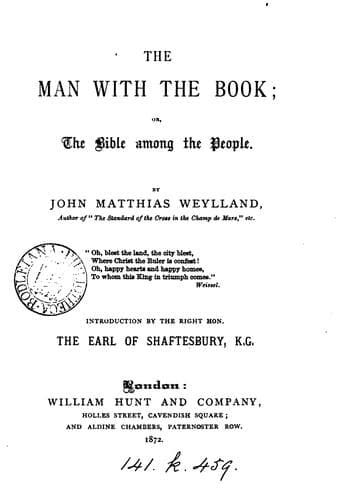
The Man with the Book; or, The Bible Among the People.Weylland, John Matthias
History
The Man with the Book; or, The Bible Among the People.
Weylland, John Matthias
City missions; London City Mission
"Thank you kindly, sir," he replied; "but I could not ask for more than
one in two months or so, though we are supposed to have every third or
fourth Sunday. I am feeling old, and a man ain't liked who is often off
his 'bus. The foreman would soon say that a younger man was ready to
take the reins; and then the workhouse, its disgrace, and separation
from as good a wife as ever lived. No, sir, personal kindness can't do
much for us Sunday slaves. No! it's getting the public to feel that
it's a disgrace to the riders, and an injury to us poor fellows, that
can alone do it."
Such were his opinions; but we soon after had the satisfaction to know
that he enjoyed one happy Christian Sabbath, and upon several journeys
we listened to his quaint remarks upon preacher and sermons. An interest
in his spiritual state (which is always akin to real friendship)
resulted; and upon many occasions instruction concerning personal
salvation was given. The last ten minutes of the journey, when we were
often alone, were valued, as, at intervals for more than a year, the
good-natured driver listened as a little child to the message of a
Redeemer's mercy. The summer and autumn had thus passed away, and during
the winter we seldom rode with him, as his hours had been changed. Upon
one of these occasions he from cold spoke with difficulty; but his
weather-beaten countenance expressed a quiet peace, as he said, "I got a
day off last Sunday week, and went to church twice. At night it was a
saying of Jesus that was preached about, 'Come unto me, all ye that
labour and are heavy laden, and I will give you rest.' The sermon made
me as happy as a prince; and after supper my Polly read the chapter
through, where it is; and then I read a Psalm which is like a prayer."
We had not after this many opportunities for conversation, but
frequently received his salute (the raising of the whip to the hat) as
we passed on other omnibuses. One fine morning towards the end of the
winter, which had been very severe, upon mounting an early 'bus, we
noticed a bow of CRAPE ON THE WHIP, and inquired concerning it. "It's
James as used to drive this 'bus," the man replied with feeling; "but he
is only one of the several old whips who have been done up this horrid
winter. He had sixteen hours a day on this box for six weeks hard off,
and had a bad cold; and when he tried for a rest Sunday, so many wanted
it that he was snubbed, and was afraid of losing his whip, and so he
kept on till he couldn't do so any longer, and then he took to his bed,
and died in a few days."
The startling intelligence produced a sense of sadness during the
journey, and led to solemn thought with desire to break fetters and let
this order of Sabbath slaves go free.
That _Crape on the Whip_ spoke of injury done to a man, and an important
class of men, and that by a too general habit of breaking a Divine law
through love of pleasure, or want of consideration.
Public-domain text, read in full here on John Shaqi.
Reviews
Reviews
No reviews yet
Be the first to share your thoughts on this work.
Elsewhere in the archive
Join the Discussion
Join the discussion
Sign in to leave a comment or review.
Sign InorCreate an account