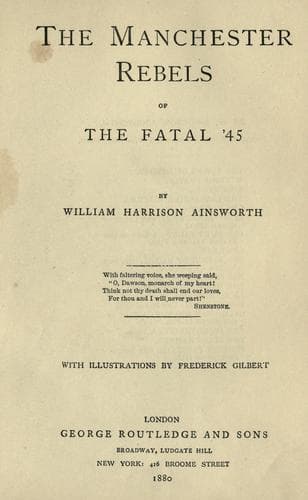
The Manchester Rebels of the Fatal '45Ainsworth, William Harrison
History
The Manchester Rebels of the Fatal '45
Ainsworth, William Harrison
Great Britain -- History -- George II, 1727-1760 -- Fiction; Jacobite Rebellion, 1745-1746 -- Fiction
"I hope I have said enough to prove how much interested I am in the
young man, and how anxious I am to promote his happiness," he said.
"Why, here he is!" he exclaimed, as Atherton was seen riding towards
the spot. "If I had summoned him, he could not have appeared more à
propos. I hope Miss Rawcliffe will not continue to look coldly upon
him."
"I am bound to obey," she rejoined, demurely.
"I wonder what message he brings me?" remarked the prince.
"I dare say your royal highness could give a shrewd guess," she
rejoined, with an almost imperceptible smile.
At this moment Atherton came up, and, removing his hat, delivered a
letter to the prince.
"From Lord George Murray," he said, still remaining uncovered.
"'Tis not very important," observed Charles, opening it, and glancing
at its contents. "But I am glad you have brought it, since it gives me
the opportunity of placing you in attendance upon Miss Rawcliffe, who
may want an escort when she quits the ground."
"I shall be charmed with the office," rejoined Atherton; "but I am not
sure that Miss Rawcliffe will be equally well pleased."
"Have no misgiving," replied Charles, with a significant look, which
implied that all was arranged. "I have some further orders to give
you, but it will be time enough when you return to head-quarters.
Meanwhile, I charge you to take especial care of these young ladies."
With this he rode off, and almost immediately afterwards quitted the
ground, accompanied by the Duke of Perth.
How much surprised Monica and Father Jerome had been by the earnest
discourse that took place between the prince and Constance, we need
scarcely state; but they were still more surprised when Atherton came
up, and was placed in attendance upon the young lady.
It was quite clear to the lookers-on that the prince had generously
taken Atherton's cause in hand, and meant to carry it through to a
successful issue. Monica, who had been much pained at the
misunderstanding between the lovers, was rejoiced; but the priest felt
differently.
Meantime, Atherton, by no means certain that he was welcome,
endeavoured to excuse himself to Constance.
"I trust Miss Rawcliffe will not blame me for this intrusion," he
said. "She can dismiss me as soon as she thinks proper."
"That would be impossible, since you have been left with me by the
prince," she rejoined. "But I have no desire to dismiss you. On the
contrary, I am glad to have an opportunity of congratulating you on
your good fortune. You have gained the prince's favour, and are
therefore on the high road to distinction."
"If I am restored to your good opinion I shall be satisfied," he
rejoined.
"My good opinion is worth little," she said.
"'Tis everything to me," he cried.
She made no direct reply, but after a moment's pause remarked:
"To-day may prove as eventful to you as yesterday. Has not the prince
acquainted you with his intentions?"
"He has told me nothing. I am ordered to attend him after the
levée--that is all."
Public-domain text, read in full here on John Shaqi.
Reviews
Reviews
No reviews yet
Be the first to share your thoughts on this work.
Elsewhere in the archive
Join the Discussion
Join the discussion
Sign in to leave a comment or review.
Sign InorCreate an account