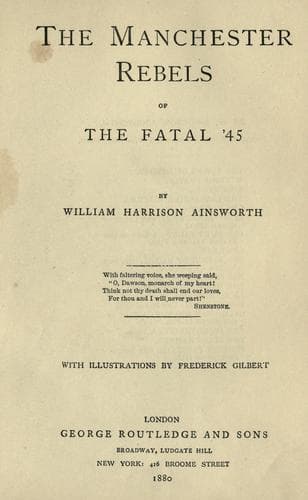
The Manchester Rebels of the Fatal '45Ainsworth, William Harrison
History
The Manchester Rebels of the Fatal '45
Ainsworth, William Harrison
Great Britain -- History -- George II, 1727-1760 -- Fiction; Jacobite Rebellion, 1745-1746 -- Fiction
For some moments Atherton could not remove his gaze from that old bed,
which seemed to exercise a sort of fascination, but when he looked at
Sir Richard, he was appalled by the terrible change that had come over
him.
He looked the picture of horror and despair. His pallid countenance
was writhen with anguish, and his limbs shook. A deep groan burst from
his labouring breast.
"The hour is near at hand," he muttered, in tones scarcely human. "But
I am not yet ready. Spare me till my task is finished!"
With a ghastly look he then added to Atherton: "The whole scene rises
before me as it occurred on that dreadful night. The room is hushed
and quiet, and within that bed a child is peacefully slumbering on his
mother's breast. A masked intruder comes in--admitted by the nurse,
who has betrayed her mistress. Unmoved by a picture of innocence that
might have touched any heart less savage than his own, he snatches up
the child, and is bearing it off when the mother awakes. Her piercing
shriek still rings through my ears. I cannot describe what
follows--but 'tis soon over--and when the worse than robber departs
with his prize, he leaves the wretched mother lying senseless on the
floor, and the nurse dead--slain by his ruthless hand!"
"Horror!" exclaimed Atherton, unable to control his feelings.
"Let us hence, or I shall become mad," cried Sir Richard, hurrying him
away.
So bewildered was Atherton, that he could scarcely tell how he
regained the library, but when he got there, he sank into a chair, and
covered his eyes with his hands, as if to exclude the terrible vision
by which he had been beset.
On rousing himself from the stupor into which he had fallen, he
perceived Sir Richard seated at the table, writing his confession, and
feeling that his presence might disturb him, he rose to depart.
Sir Richard rose likewise, and while conducting him to the door, said:
"I will send for you when I have done. I shall be best alone for a
short time. But let me give you a word of counsel, and do not distrust
it because it comes from me. 'Tis my wish, as you know, to repair the
wrong I have done. I would not have you forfeit the lofty position you
have just obtained."
"I hope I shall not forfeit it," said Atherton, proudly.
"You will not long hold it," rejoined Sir Richard, in a solemn tone,
"unless you withdraw from this ill-fated expedition. It will end in
your destruction. Attend to my warning!"
"I cannot honourably retreat," said Atherton.
"You must," cried Sir Richard, sternly. "Why throw away your life from
a fancied sense of honour, when such fair prospects are opening upon
you? 'Twill be madness to persist."
Atherton made no reply, and Sir Richard said no more.
But as he opened the door he gave the young man a look so full of
strange significance that he almost guessed its import.
Sir Richard paused for a moment as he went back to the table.
Public-domain text, read in full here on John Shaqi.
Reviews
Reviews
No reviews yet
Be the first to share your thoughts on this work.
Elsewhere in the archive
Join the Discussion
Join the discussion
Sign in to leave a comment or review.
Sign InorCreate an account