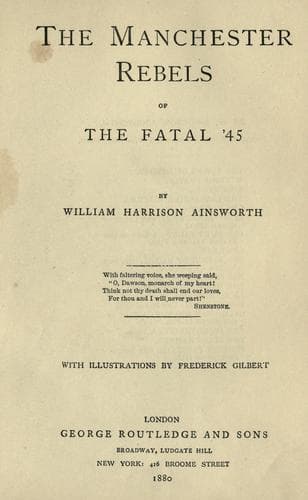
The Manchester Rebels of the Fatal '45Ainsworth, William Harrison
History
The Manchester Rebels of the Fatal '45
Ainsworth, William Harrison
Great Britain -- History -- George II, 1727-1760 -- Fiction; Jacobite Rebellion, 1745-1746 -- Fiction
The room was empty; but it was evident that the dreadful catastrophe
he anticipated had taken place in the inner room, since a dark stream
of blood could be seen trickling beneath the door, which was standing
ajar.
Atherton endeavoured to push it open, but encountering some
resistance, was obliged to use a slight degree of force to accomplish
his object, and he then went in, closely followed by the others.
A dreadful spectacle met their gaze. Stretched upon the floor amid a
pool of blood, with a pistol grasped in his hand, showing how the deed
had been done, lay Sir Richard.
[Illustration: DEATH OF SIR RICHARD RAWCLIFFE
Page 201.]
He had shot himself through the heart, so that his death must have
been almost instantaneous.
The sight would have been ghastly enough under any circumstances;
but beheld in that chamber, so full of fearful associations,
it acquired additional horror. The group gathered round the
body--the young baronet in his military attire--the Highlander
in his accoutrements--and the old butler--formed a striking
picture. That the guilty man should die there seemed like the
work of retribution.
As the nephew he had so deeply injured, and deprived of his
inheritance, looked down upon his dark and stern visage, now
stilled in death, he could not but pity him.
"May Heaven forgive him, as I forgive him!" he ejaculated.
"If he has sinned deeply his penitence has been sincere," said
Markland, sorrowfully. "Half his time has been spent in fasting
and prayer. Heaven have mercy on his sinful soul!"
"It seems to me as if he had something clutched in his left hand,"
remarked the sergeant.
"I think so, too," said Atherton. "See what it is."
Thereupon, Erick knelt down beside the body, and opening the fingers,
which were not yet stiffened, took from them a small slip of paper,
and gave it to Atherton.
It had been crushed in the death gripe, but on being unfolded, these
warning words appeared:
"'Tis given to those on the point of death to see into the future,
and I read danger and destruction in the expedition you have joined.
Be warned by your unhappy uncle, and abandon it."
"Whatever may be the consequence, I cannot abandon the expedition,"
thought Atherton.
While forming this resolution, he gazed at his lifeless monitor, and
it seemed to him as if a frown passed over the dead man's countenance.
CHAPTER XXXI.
SIR RICHARD RAWCLIFFE'S CONFESSION.
After considering what ought to be done under circumstances so painful
and extraordinary, Atherton left Sergeant Dickson with the body, and
then descending with Markland to the hall, ordered him to assemble the
whole house without delay, and acquaint them with the dreadful
catastrophe that had occurred.
Thereupon, Markland rang the alarm bell, and the summons was immediately
answered by all the male part of the household, and several women, who
hurried to the entrance-hall to see what was the matter.
Public-domain text, read in full here on John Shaqi.
Reviews
Reviews
No reviews yet
Be the first to share your thoughts on this work.
Elsewhere in the archive
Join the Discussion
Join the discussion
Sign in to leave a comment or review.
Sign InorCreate an account