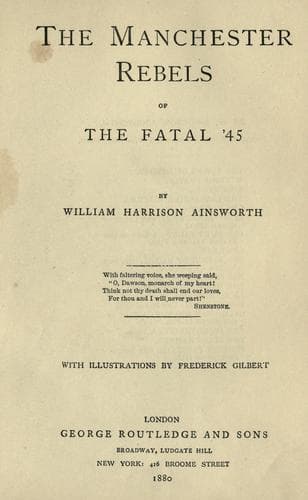
The Manchester Rebels of the Fatal '45Ainsworth, William Harrison
History
The Manchester Rebels of the Fatal '45
Ainsworth, William Harrison
Great Britain -- History -- George II, 1727-1760 -- Fiction; Jacobite Rebellion, 1745-1746 -- Fiction
The men looked sullen and downcast, and so many desertions took place
that the ranks were perceptibly thinned. It was certain that two or
three of the officers only waited a favourable opportunity to escape.
On the third day the Manchester Regiment, which formed part of the
advanced guard, arrived at Macclesfield. Next morning, at an early
hour, they proceeded to Manchester. Alarming reports had been spread
that the Duke of Cumberland was in hot pursuit with his whole army;
but the rumour turned out to be false.
If the officers and men composing the insurgent army expected a
reception like that they had previously experienced in Manchester,
they were greatly mistaken. No sooner was the town cleared of the
invading army, than the Whigs and Presbyterians resumed their
influence, and the fickle mob changed with them.
Tumultuous crowds now went about the town shouting "Down with the
Pretender! Down with the Jacobites!" Nor did the authorities
interfere, but let them have their own way.
In consequence of this license great mischief was done. The mob
threatened to pull down Dr. Deacon's house in Fennel-street, broke his
windows, and might have proceeded to frightful extremities if they had
laid hands upon him.
Two days afterwards a rumour was designedly spread by the
Presbyterians that Marshal Wade had arrived at Rochdale with his army,
and would shortly enter Manchester; and this had the effect intended
of exciting the mob to further violence. The rumour, however, had no
foundation, and the tumult began to subside.
Meantime, the magistrates and many of the important personages who had
quitted the town, began to return, thinking the danger was past, and
something like order was restored.
The position, however, of the Jacobites was by no means secure, since
disturbances might at any time occur, and they were afforded very
little protection.
After the lapse of a week, during which reliable intelligence had been
received that the Highland army had arrived at Derby without
encountering any opposition, and even staunch Whigs had began to think
that the intrepid young prince would actually succeed in reaching
London, news came that the rebels were retreating without a battle,
and were then at Leek on their way back.
At first this news, which appeared improbable, was received with
incredulity, but it was speedily confirmed by other messengers.
A consultation was then held by the boroughreeve, constables, and
other magistrates, as to the possibility of offering any resistance;
but as the militia had been disbanded, and it was doubtful whether
Marshal Wade would come to their assistance, the idea was given up.
Public-domain text, read in full here on John Shaqi.
Reviews
Reviews
No reviews yet
Be the first to share your thoughts on this work.
Elsewhere in the archive
Join the Discussion
Join the discussion
Sign in to leave a comment or review.
Sign InorCreate an account