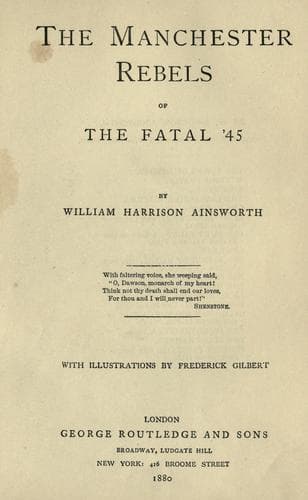
The Manchester Rebels of the Fatal '45Ainsworth, William Harrison
History
The Manchester Rebels of the Fatal '45
Ainsworth, William Harrison
Great Britain -- History -- George II, 1727-1760 -- Fiction; Jacobite Rebellion, 1745-1746 -- Fiction
The sergeant was then deprived of his arms, and the pistol with which
he had fired the fatal shot was picked up, and preserved as evidence
against him.
As Erick and Helen were marched off in the midst of the guard, another
file of men entered the churchyard, took up the body of the
unfortunate Captain Lindsay, and conveyed it to the quarters of the
commanding officer.
CHAPTER VII.
A COURT-MARTIAL.
Delivered over to the custody of the provost, the unfortunate Sergeant
Dickson was placed in the guard-room near the prince's head-quarters,
and a sentinel was stationed at the door. Helen was allowed to remain
with him. The greatest sympathy was felt for the sergeant, for he was
a universal favourite.
Full of anxiety, Captain Dawson sought an interview with the prince,
who, though engaged on business, immediately received him.
Charles looked very grave.
"I am greatly distressed by what has happened," he said. "There is not
a man in my whole army for whom I have a greater regard than Erick
Dickson, but I fear his sentence will be death. However, I will do
what I can for him. A court-martial shall be held immediately, and I
have sent for Lord George Murray to preside over it, and we must wait
the result of the investigation. As yet I cannot interfere."
As the prince had ordered that the examination should take place
without delay, a court-martial was held in a room on the ground floor
of the mansion occupied by his royal highness. Lord George Murray
presided, and with him were Lord Elcho, Lord Pitsligo, Colonel
Townley, and the Chevalier de Johnstone; Captain Legh, Captain Deacon,
Captain Dawson, and several other officers were likewise present.
The president occupied a raised chair at the head of the table, round
which the others were seated. The room was only imperfectly lighted.
After a short deliberation, the prisoner was brought in by two
soldiers, who stood on either side of him.
Bowing respectfully to the court, he drew himself up to his full
height, and maintained a firm deportment throughout his examination.
"Sergeant Dickson," said Lord George Murray, in a stern and solemn
voice, "you are charged with the dreadful crime of murder--aggravated
in your instance, because your hand has been raised against your
superior officer. If you have aught to state in mitigation of your
offence, the court will listen to you."
"My lord," replied Dickson, firmly, "I confess myself guilty of the
crime with which I am charged. I did shoot Captain Lindsay, but
perhaps the provocation I received, which roused me beyond all
endurance, may be held as some extenuation of the offence. Nothing, I
am well aware, can justify the act. My lord, I could not see the girl
I love carried off before my eyes, and not demand her release. Captain
Lindsay refused--mocked me--and I shot him. That is all I have to
say."
Brief as was this address, it produced a most powerful effect. After a
short deliberation by the court, Lord George thus addressed the
prisoner:
Public-domain text, read in full here on John Shaqi.
Reviews
Reviews
No reviews yet
Be the first to share your thoughts on this work.
Elsewhere in the archive
Join the Discussion
Join the discussion
Sign in to leave a comment or review.
Sign InorCreate an account