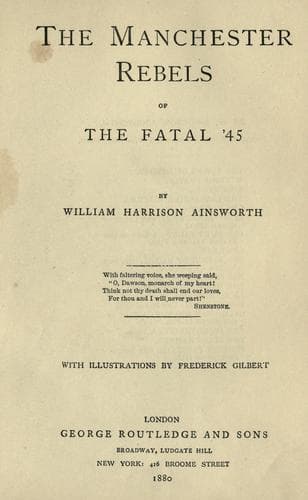
The Manchester Rebels of the Fatal '45Ainsworth, William Harrison
History
The Manchester Rebels of the Fatal '45
Ainsworth, William Harrison
Great Britain -- History -- George II, 1727-1760 -- Fiction; Jacobite Rebellion, 1745-1746 -- Fiction
The court then deliberated for a short time, during which Lord George
was earnestly addressed in a low tone both by Colonel Townley and the
Chevalier de Johnstone, but his countenance remained very grave.
At last, amid profound silence, he addressed the prisoner in the
following terms: "Sergeant Dickson, the court has taken into
consideration your excellent character, and the strong provocation
that impelled you to commit this desperate act, and which certainly
mitigates the offence; and such is our pity for you, that, were it in
our power; we would pardon your offence, or at all events would visit
it with a slight punishment; but we have no option--leniency on our
part would be culpable. You have murdered an officer, and must die.
Sentence of death is therefore passed upon you by the court."
"I expected this, my lord," observed the sergeant firmly, "and am
prepared to meet my fate. But I would not die as a murderer."
"The crime you have committed is murder," said Lord George; "and I can
hold out no hope whatever of pardon. You are too good a soldier not to
know that if your life were spared it would be an ill example to the
army, besides being a violation of the law."
An awful pause ensued.
The profound silence was then broken by the prisoner, who said, in a
low, firm voice:
"All the grace I will ask from your lordship and the court is, that
execution of the sentence you have passed upon me, the justice of
which I do not deny, may not be delayed."
"We willingly grant your request," replied Lord George. "The execution
shall take place at an early hour in the morning."
"I humbly thank your lordship," said Dickson. "But I would further
pray that my affianced wife, who has been unwittingly the cause of
this disaster, be permitted to bear me company during the few hours I
have left; and that she also be permitted to attend my execution."
"To the former part of the request there can be no objection," said
Lord George. "Helen shall remain with you during the night, but she
can scarcely desire to be present at your execution."
"She will never leave me to the last," said the sergeant.
"Be it as you will," replied Lord George.
The sergeant was then removed by the guard, and given in charge of the
provost, and the court broke up.
CHAPTER VIII.
HELEN PLEADS IN VAIN.
Immediately after the breaking up of the court, Lord George Murray and
the other members of the council waited upon the prince to acquaint
him with their decision.
Though greatly pained, he thought they were right, and after some
discussion they retired and left him alone.
But the prince was so much troubled, that though excessively fatigued
he could not retire to rest, but continued to pace his chamber till
past midnight, when Captain Dawson entered and informed him that Miss
Byrom earnestly craved an audience of him.
"She is not alone," added Jemmy. "Helen Carnegie is with her."
Public-domain text, read in full here on John Shaqi.
Reviews
Reviews
No reviews yet
Be the first to share your thoughts on this work.
Elsewhere in the archive
Join the Discussion
Join the discussion
Sign in to leave a comment or review.
Sign InorCreate an account