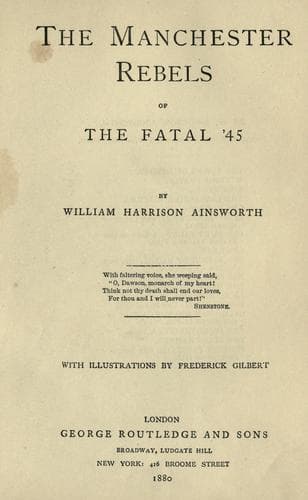
The Manchester Rebels of the Fatal '45Ainsworth, William Harrison
History
The Manchester Rebels of the Fatal '45
Ainsworth, William Harrison
Great Britain -- History -- George II, 1727-1760 -- Fiction; Jacobite Rebellion, 1745-1746 -- Fiction
The sergeant's deportment was resolute, and he held his head erect. He
was in full Highland costume, and wore his bonnet and scarf.
All the spectators were struck by his tall fine figure, and grieved
that such a splendid man should be put to death.
But Helen excited the greatest sympathy. Though her features were
excessively pale, they had lost none of their beauty. The occasional
quivering of her lip was the only external sign of emotion, her step
being light and firm. Her eyes were constantly fixed upon her lover.
Prayers were read by the chaplain as they marched along.
The execution party brought up the rear of the melancholy procession.
As it moved slowly through a side street towards the field, the number
of spectators increased, but the greatest decorum was observed.
At length the place of execution was reached. It was the spot where
the attempt had been made to capture the prince; and on that dull and
dismal morning had a very gloomy appearance, quite in harmony with the
tragical event about to take place.
On reaching the centre of the field, the detachment of Highlanders
formed a semicircle, and a general halt took place--the prisoner and
those with him standing in the midst, and the execution party
remaining at the back.
Some short prayers were then recited by Mr. Coppock, in which both the
sergeant and Helen joined very earnestly.
These prayers over, the sergeant took leave of Helen, and strained her
to his breast.
At this moment, her firmness seemed to desert her, and her head fell
upon his shoulder. Colonel Johnstone stepped forward, and took her
gently away.
The provost then ordered a handkerchief to be bound over the
sergeant's eyes, but at the prisoner's earnest request this formality
was omitted.
The fatal moment had now arrived. The detachment of Highlanders drew
back, and Erick knelt down.
The execution party made ready, and moved up within six or seven yards
of the kneeling man.
"Fire!" exclaimed Syddall, and the fatal discharge took place--doubly
fatal as it turned out.
At the very instant when the word was given by Syddall, Helen rushed
up to her lover, and kneeling by his side, died with him.
Her faithful breast was pierced by the same shower of bullets that
stopped the beating of his valiant heart.
CHAPTER X.
MR. JAMES BAYLEY.
In spite of the exertions of the magistrates, only a very small sum
could be obtained from the inhabitants of the town, upon which another
meeting took place at the Bull's Head, and a deputation was formed to
wait upon the prince.
Accordingly, a large body of gentlemen proceeded to the prince's
head-quarters, and some half-dozen of them, including the two
magistrates and Mr. James Bayley, were ushered into the
council-chamber, where they found Charles and his secretary.
Mr. Fowden, who acted as spokesman, represented to the prince the
utter impossibility of raising the money, and besought that the
payment might be excused.
Charles, however, answered sternly:
Public-domain text, read in full here on John Shaqi.
Reviews
Reviews
No reviews yet
Be the first to share your thoughts on this work.
Elsewhere in the archive
Join the Discussion
Join the discussion
Sign in to leave a comment or review.
Sign InorCreate an account