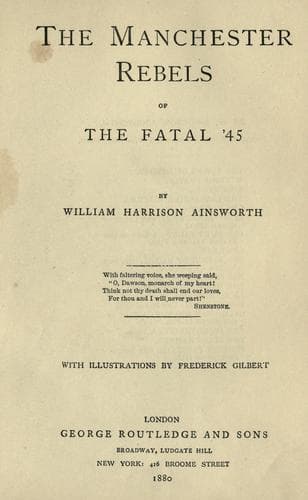
The Manchester Rebels of the Fatal '45Ainsworth, William Harrison
History
The Manchester Rebels of the Fatal '45
Ainsworth, William Harrison
Great Britain -- History -- George II, 1727-1760 -- Fiction; Jacobite Rebellion, 1745-1746 -- Fiction
However, as the rear-guard of the army was passing down Smithy Bank to
the bridge, a shot was fired from a garret-window, by which a dragoon
was killed, upon which the regiment immediately faced about, and the
colonel commanding it was so enraged that he gave orders to fire the
town.
In an instant all was confusion and dismay. The men, who were quite as
infuriated as their leader, were preparing to execute the order, when
they were pacified by the capture of the author of the outrage, and
summary justice having been inflicted upon him, the regiment quitted
Manchester, very much to the relief of the inhabitants.
On that night the prince slept at Wigan; on the following day he
marched with his whole forces to Preston, and here Atherton joined
him.
Next day, Charles pursued his march to Lancaster, where he remained
for a couple of days to recruit his men before entering upon the fells
of Westmoreland.
After quitting Lancaster, the army moved on in two divisions, one of
which rested at Burton, and the other at Kirkby Lonsdale, but they
joined again at Kendal, and then continued their march over Shap
Fells. The weather was exceedingly unpropitious, and the fine views
from the hills were totally obscured by mist.
The prince's deportment seemed entirely changed. He had quite lost the
spirit and ardour that characterised him on the onward march, and he
seemed perpetually to regret that he had turned back. He thought he
had thrown away his chance, and should never recover it.
One day he unburdened his breast to Captain Legh, for whom he had
conceived a great regard, and said:
"I ought to have gone on at all hazards. The army would not have
abandoned me--even if their leaders had turned back. By this time I
should have been master of London--or nothing."
In vain Atherton tried to cheer him. For a few minutes he roused
himself, but speedily relapsed into the same state of dejection.
Heretofore, as we have stated, the prince had marched on foot at the
head of one column of the army, but he now left the command of this
division to the Duke of Perth, and rode in the rear, attended by the
Marquis d'Eguilles, Sir Thomas Sheridan, Secretary Murray, and Captain
Legh.
Lord George Gordon commanded the rear-guard, and was more than a day's
march behind the van--great fears being entertained lest the
retreating army should be overtaken by the Duke of Cumberland, who was
in full pursuit. At length, these apprehensions were realised.
The duke came up with the rear-guard at Clifton, near Penrith, and
immediately attacked it, but was most vigorously and successfully
repulsed by Lord George; and little doubt can be entertained that if
Charles, who was at Penrith, had sent reinforcements, the duke would
have been defeated, and perhaps might have been taken prisoner.
Be this as it may, the pursuit was checked, and Charles reached
Carlisle without further interruption.
End of the Third Book.
BOOK IV.
CARLISLE.
CHAPTER I.
Public-domain text, read in full here on John Shaqi.
Reviews
Reviews
No reviews yet
Be the first to share your thoughts on this work.
Elsewhere in the archive
Join the Discussion
Join the discussion
Sign in to leave a comment or review.
Sign InorCreate an account