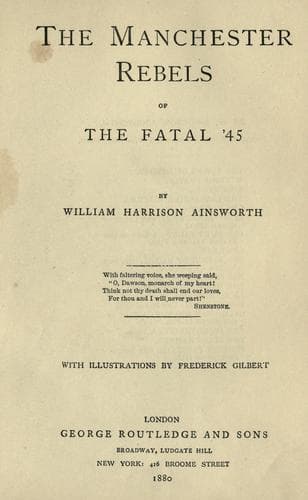
The Manchester Rebels of the Fatal '45Ainsworth, William Harrison
History
The Manchester Rebels of the Fatal '45
Ainsworth, William Harrison
Great Britain -- History -- George II, 1727-1760 -- Fiction; Jacobite Rebellion, 1745-1746 -- Fiction
"I don't mind that," replied the other. "The moment I saw you, I
determined to liberate you. I dare say you've forgotten the
circumstance, but I haven't. You saved me from being drowned in the
Irwell--now we're quits. I'm going to take you to the old Manor House
in Bishopsgate Street. It belongs to Captain Hulton, who is in the
king's army, but he is away, and my aunt, Mrs. Scholes, who is his
housekeeper, has charge of the house. She is a staunch Jacobite. I
have seen her and told her all about you. You may trust her
perfectly."
Proceeding with the utmost caution, they soon came to Bishopsgate
Street, in which the old Manor House was situated.
Taking his companion to the back of the premises, Holgate tapped at a
door, which was immediately opened by a very respectable-looking
middle-aged woman, who curtsied to Atherton as she admitted him.
Holgate did not enter the house, but with a hasty "good-night,"
departed, and the door was closed and bolted.
Mrs. Scholes then took Atherton to the kitchen, and explained that she
meant to put him in the "secret room" in case the house should be
searched.
"You will be indifferently lodged, sir," she said; "but you will be
safe, and that's the chief thing."
Atherton entirely concurred with her, and without wasting any further
time in talk, she led him up a back staircase to a bedroom, from which
there was a secret entrance through a closet, to a small inner
chamber. The latter was destined for Atherton, and scantily furnished
as it was, he was very well content with it, and slept soundly in the
little couch prepared for him.
Next morning, when the prisoners were mustered, the greatest
consternation was caused by the discovery that Captain Legh was
missing. It was quite clear that he had got out of the window, and it
was equally clear that the sentinel must have neglected his duty, or
the prisoner could not have escaped; but no suspicion attached to the
landlord.
Of course the departure of the waggons was delayed, and strict search
was made for the fugitive throughout the town. A proclamation was
likewise issued, announcing that any one harbouring him would be
liable to severe penalties. But the notice had no effect.
In consequence of some information received by the officer in command
of the escort that two persons had been seen to enter the Manor House
in Bishopsgate Street late at night, the house was strictly searched,
but the secret chamber was not discovered, nor was anything found to
indicate that the fugitive was concealed there.
CHAPTER II.
THE MEETING AT WARRINGTON.
At Warrington, where the visitors were conveyed next day, a meeting
took place between Jemmy and Monica, who had come over from Rawcliffe
Hall to see her unfortunate lover. She was accompanied by Father
Jerome.
Jemmy was alone in a little parlour of the inn at which the waggons
had stopped, when Monica was admitted by the guard, who immediately
withdrew, and left them together.
Public-domain text, read in full here on John Shaqi.
Reviews
Reviews
No reviews yet
Be the first to share your thoughts on this work.
Elsewhere in the archive
Join the Discussion
Join the discussion
Sign in to leave a comment or review.
Sign InorCreate an account