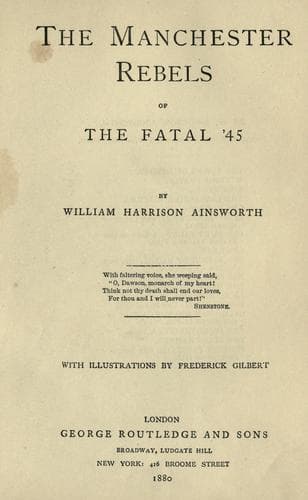
The Manchester Rebels of the Fatal '45Ainsworth, William Harrison
History
The Manchester Rebels of the Fatal '45
Ainsworth, William Harrison
Great Britain -- History -- George II, 1727-1760 -- Fiction; Jacobite Rebellion, 1745-1746 -- Fiction
Not having anything better to do, Atherton began to wander about the
deserted suite of apartments, with which his own chamber communicated
by a side door.
As the windows were closed, the rooms looked very dark, and he could
see but little, and what he did see, impressed him with a melancholy
feeling; but the furthest room in the suite looked lighter and more
cheerful than the others, simply because the shutters had been opened.
It was a parlour, but most of the furniture had been removed, and only
a few chairs and a table were left.
Atherton sat down, and was ruminating upon his position, when a door
behind was softly opened--so very softly that he heard no sound.
But he felt a gentle touch on his shoulder, and, looking up, beheld
Constance standing beside him.
When he met her in the park with Monica, he had not noticed any
material alteration in her appearance; but now that he gazed into her
face, he was very much struck by the change which a week or two had
wrought in her looks.
Dressed in deep mourning, she looked much thinner than heretofore, and
the roses had entirely flown from her cheeks; but the extreme paleness
of her complexion heightened the lustre of her magnificent black eyes,
and contrasted forcibly with her dark locks, while the traces of
sadness lent fresh interest to her features.
Not without anxiety did Atherton gaze at her, and at last he said:
"You have been ill, Constance?"
"Not very ill," she replied, with a faint smile. "I am better--and
shall soon be quite well. My illness has been rather mental than
bodily. I have never quite recovered from the terrible shock which I
had to undergo--and, besides, I have been very uneasy about you. Now
that you are safe I shall soon recover my health and spirits. At one
time I feared I should never behold you again, and then I began to
droop."
"I thought you possessed great firmness, Constance," he remarked.
"So I fancied, but I found myself unequal to the trial," she rejoined.
"I had no one to cheer me. Monica's distress was even greater than my
own, and her mother did not offer us much consolation, for she seemed
convinced that both you and Jemmy were doomed to die as traitors."
"Well, your apprehensions are now at an end, so far as I am
concerned," said Atherton; "and I see no cause for uneasiness in
regard to Jemmy, for he is certain to escape in one way or other. I
hope to meet him a month hence in Paris. But I shall not leave England
till I learn he is free, as if he fails to escape, I must try to
accomplish his deliverance."
"Do not run any further risk," she cried.
"I have promised to help him, and I must keep my word," he rejoined.
"I ought not to attempt to dissuade you, for I love Jemmy dearly, but
I love you still better, and I therefore implore you for my sake--if
not for your own--not to expose yourself to further danger. I will now
tell you frankly that I could not go through such another week as I
have just passed."
Public-domain text, read in full here on John Shaqi.
Reviews
Reviews
No reviews yet
Be the first to share your thoughts on this work.
Elsewhere in the archive
Join the Discussion
Join the discussion
Sign in to leave a comment or review.
Sign InorCreate an account