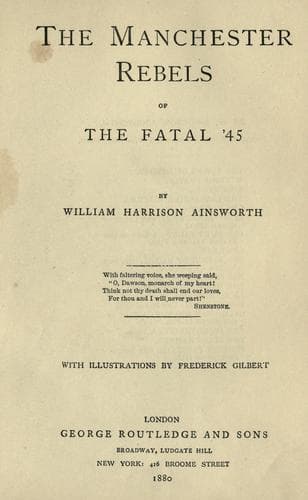
The Manchester Rebels of the Fatal '45Ainsworth, William Harrison
History
The Manchester Rebels of the Fatal '45
Ainsworth, William Harrison
Great Britain -- History -- George II, 1727-1760 -- Fiction; Jacobite Rebellion, 1745-1746 -- Fiction
Shortly afterwards, the butler took his departure, and Atherton was
again left to himself for several hours.
When evening came, Markland had not reappeared; but doubtless
something had detained him, and concluding all was right, Atherton
descended the private staircase, and passed through the secret door
into the library.
Constance was there and alone. Lights were placed upon the table
beside which she was seated. She was reading a letter at the moment,
and seemed deeply interested in its contents; but on hearing his
footsteps, she rose to welcome him.
"This letter relates entirely to you," she said.
"And judging from your looks it does not bring good news," he
remarked.
"It does not," she rejoined. "It is from Beppy Byrom, and was brought
by a special messenger from Manchester. She informs me that a warrant
for your arrest has just been received by the authorities of the town,
who are enjoined to offer a reward for your capture. Strict search
will, consequently, be made for you, she says; and as Rawcliffe Hall
may be visited, she sends this notice. She also states that it will be
impossible to escape to France from any English port, as an embargo is
now laid on all vessels. The letter thus concludes: 'If you have any
communication with Captain Legh, pray tell him, if he should be driven
to extremity, he will find an asylum in my father's house.'"
"Have you returned any answer to this kind letter?" inquired Atherton.
"No--it would not have been prudent to detain the messenger. During
his brief stay, Markland took care he should not have any conversation
with the servants. Father Jerome was curious to ascertain the nature
of his errand, and learnt that he came from Manchester--but nothing
more. I know not what you may resolve upon; but if you decide on
flight, you will need funds. In this pocket-book are bank-notes to a
considerable amount. Nay, do not hesitate to take it," she added, "you
are under no obligation to me. The money is your own."
Thus urged, Atherton took the pocket-book, and said:
"Before I decide upon the steps I ought to take in this dangerous
emergency, let me mention a matter to you that has weighed upon my
mind. In yonder cabinet are certain papers which I desire to confide
to your care. They contain proofs that I am the rightful heir to this
property--the most important of the documents being a statement drawn
up by your father, and signed by him, immediately before his death.
Now listen to me, Constance. Should I fall into the hands of the
enemy--should I die the death of a traitor--it is my wish that those
documents should never be produced."
Constance could not repress an exclamation.
"All will be over then," he proceeded, calmly. "And why should a dark
story, which can only bring dishonour on our family, be revealed? Let
the secret be buried in my grave. If I am remembered at all, let it be
as Atherton Legh, and not as Oswald Rawcliffe."
Public-domain text, read in full here on John Shaqi.
Reviews
Reviews
No reviews yet
Be the first to share your thoughts on this work.
Elsewhere in the archive
Join the Discussion
Join the discussion
Sign in to leave a comment or review.
Sign InorCreate an account