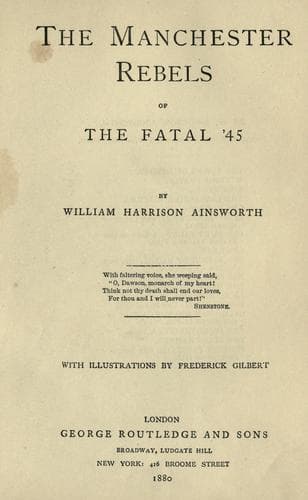
The Manchester Rebels of the Fatal '45Ainsworth, William Harrison
History
The Manchester Rebels of the Fatal '45
Ainsworth, William Harrison
Great Britain -- History -- George II, 1727-1760 -- Fiction; Jacobite Rebellion, 1745-1746 -- Fiction
"You are too kind-hearted, I am sure, Mr. Fowden," said Constance,
"not to be better pleased that things have turned out thus, than if
you had carried back a prisoner. And pray don't trouble yourself about
the loss of your horse. You shall have the best in the stable. But you
won't think of returning to Manchester to-night."
"Well--no," he replied, after a few moments' deliberation. "I am very
comfortable here, and don't feel inclined to stir. I shouldn't be
surprised if we had some intelligence before morning."
"Very likely," replied Constance; "and I think you have decided wisely
to remain. It's a long ride at this time of night."
Mr. Fowden, as we have shown, was very good-tempered, and disposed to
take things easily.
He was secretly not sorry that Atherton had eluded him, though he
would rather the escape had been managed differently.
However it was quite clear it could not have been accomplished by his
connivance. That was something.
Consoled by this reflection, he finished his supper as quietly as if
nothing had occurred to interrupt it.
Immediately after supper Constance and her cousin retired, and left
him to enjoy a bottle of claret with the priest.
They were still discussing it when a great bustle in the court-yard
announced that the constables had come back.
"Here they are!" cried the magistrate, springing to his feet. "I must
go and see what has happened."
And he hurried out of the room, followed by Father Jerome.
By the time they reached the court-yard the constables had dismounted,
and were talking to Markland and the gate-porter. Two other
men-servants were standing by, bearing torches.
No sooner did Mr. Fowden make his appearance than one of the
constables came up.
"Here's a pretty business, sir," said the man in an apologetic tone.
"We've been nicely taken in. We thought we had you with us, and never
suspected anything wrong till we got out of the park, when the
gentleman at our head suddenly dashed off at full speed, and
disappeared in the darkness. We were so confounded at first that we
didn't know what to do, but the truth soon flashed upon us, and we
galloped after him as hard as we could. Though we could see nothing of
him, the clatter of his horse's hoofs guided us for a time, but
by-and-by this ceased, and we fancied he must have quitted the road
and taken to the open. We were quite certain he hadn't forded the
Mersey, or we must have heard him."
"No--no--he wouldn't do that, Glossop," remarked the magistrate.
"Well, we rode on till we got to a lane," pursued the constable, "and
two of our party went down it, while the rest kept to the high road.
About a mile further we encountered a waggon, and questioned the
driver, but no one had passed him; so we turned back, and were soon
afterwards joined by our mates, who had been equally unsuccessful.
Feeling now quite nonplussed, we deemed it best to return to the
hall--and here we are, ready to attend to your honour's orders."
Public-domain text, read in full here on John Shaqi.
Reviews
Reviews
No reviews yet
Be the first to share your thoughts on this work.
Elsewhere in the archive
Join the Discussion
Join the discussion
Sign in to leave a comment or review.
Sign InorCreate an account